
Web scraping proxies are easy to oversimplify. Many comparison pages reduce the decision to a list of companies, an advertised IP pool, and a “best overall” badge. I do not think that is how a serious buyer should choose a provider. The right proxy depends on what you are collecting, where the public data appears, whether you need a stable session or a rotating IP, how frequently the source changes, and whether an API or licensed data source would be a better fit. In other words, the best proxy is not necessarily the biggest network or the least expensive plan. It is the one that produces accurate, usable data without creating unnecessary cost, risk, or operational complexity.
In this guide, I break down the proxy types that matter, compare established providers using criteria that buyers can actually verify, and explain the questions I would ask before signing an annual contract. I also cover responsible request rates, location accuracy, session management, proxy sourcing, and data-quality measurement. Basically, this is not a “buy this provider because it has millions of IPs” article. It is a practical framework for selecting web scraping proxies based on your real data requirements.
Editorial note: Provider pricing, IP-pool size, country availability, and feature sets can change quickly. I recommend verifying current details directly with the provider and running a limited pilot before committing to a long-term plan. Figures below were checked against provider pages and independent benchmarks in mid-2026 and are given as ranges — vendors frequently quote different numbers depending on volume tier, promo codes, and which page you land on, so treat every number here as a starting point for your own trial, not a quote. If this page contains affiliate links or commercial relationships, disclose them clearly.
Quick Answer: What Are the Best Proxies for Web Scraping?
There is no single best proxy provider for every web scraping project. However, several providers consistently appear in serious procurement conversations:
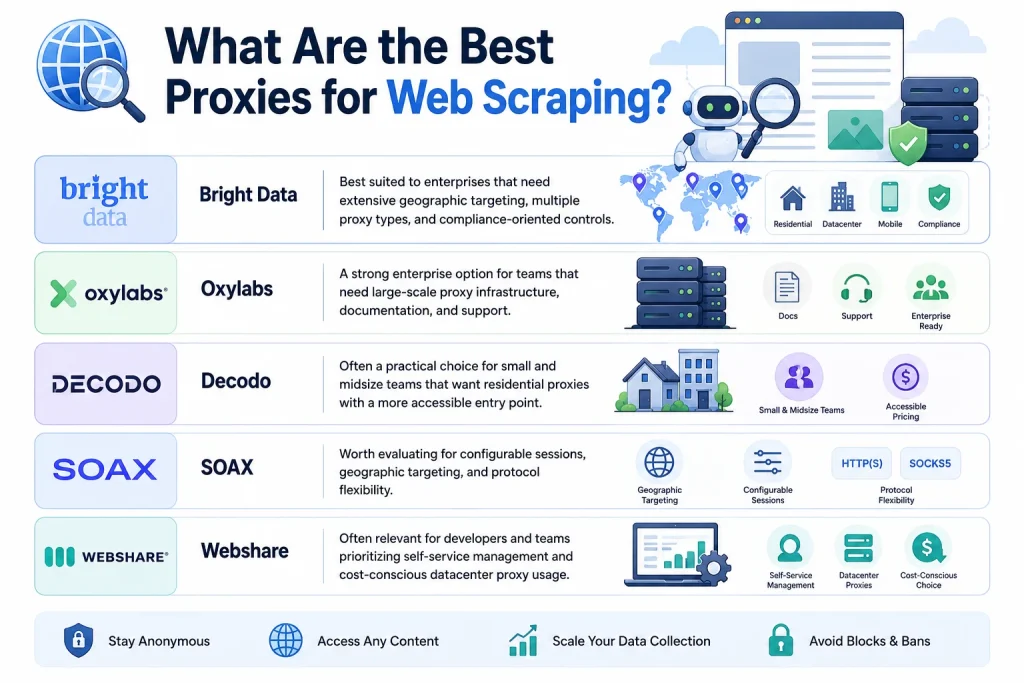
- Bright Data: Best suited to enterprises that need extensive geographic targeting, multiple proxy types, and compliance-oriented controls.
- Oxylabs: A strong enterprise option for teams that need large-scale proxy infrastructure, documentation, and support.
- Decodo: Often a practical choice for small and midsize teams that want residential proxies with a more accessible entry point.
- SOAX: Worth evaluating for configurable sessions, geographic targeting, and protocol flexibility.
- Webshare: Often relevant for developers and teams prioritizing self-service management and cost-conscious datacenter proxy usage.
- Rayobyte: A US-based option worth a look for teams that want a smaller, ethics-forward provider with transparent sourcing.
- Geonode: A budget-oriented option for teams that want low per-GB pricing and don’t need a bundled scraping API.
The provider matters, but the proxy type matters first. For example, a permitted product-catalog project might run efficiently with datacenter proxies, while a localized ad-verification project could require residential or ISP proxies in specific markets.
Before comparing vendors, make sure your team understands what web scraping is and how it works, along with the distinction between web scraping and web crawling. Those terms are often used interchangeably, but they describe different operational goals.
Comparison Table: Leading Proxy Providers for Web Scraping
The table below is designed as a starting point for evaluation, not a substitute for testing. Provider-reported performance figures should always be validated against the public websites, countries, response volumes, and compliance requirements relevant to your project. Price-per-GB figures reflect residential proxies (the most commonly compared product) and span the range from pay-as-you-go entry rates down to volume-committed rates; your actual rate depends heavily on which tier you land on.
| Provider | Best for | Price per GB (residential) | Pool Size (IPs) | Geo Targeting | Standout capabilities | What I would verify during a trial |
|---|---|---|---|---|---|---|
| Bright Data | Enterprise-scale web data collection and detailed location targeting | ~$2.50–$8.40/GB (PAYG to committed) | 400M+ across 195 countries | Country, city, ZIP, ASN, carrier | Country, city, ZIP code, ASN, and carrier targeting where supported; broad product range | Exact location availability, usable response rate, support quality, and total bandwidth cost |
| Oxylabs | Large teams needing technical documentation, support, and proxy infrastructure | ~$2.50–$8/GB (PAYG to committed) | 175M+ across 195 countries | Country, city, state, ZIP | Residential rotation, location targeting, enterprise-oriented tooling | Target-country performance, session behavior, data quality, and account controls |
| Decodo | SMBs, agencies, and teams seeking a straightforward proxy platform | ~$2–$4/GB (PAYG rates vary by source) | 115M+ across 195+ locations | Country, state, city, ZIP (US), ASN — included free | Rotating and sticky sessions, HTTP(S)/SOCKS5 support, geographic targeting | Traffic consumption, country coverage, dashboard controls, and parsing success |
| SOAX | Teams needing flexible session configuration and location controls | ~$2–$4/GB, tiered down at volume | 155M+ residential (191M+ total incl. mobile) across 195 countries | Country, region, city, ISP/ASN, ZIP | Custom session duration, city/ASN targeting, multiple protocols | Geographic precision, sticky-session consistency, and policy fit |
| Webshare | Budget-conscious developers and self-service proxy users | ~$1.40–$7/GB depending on tier | 80M+ across 195 countries | Country, city (ASN/ZIP more limited) | Proxy lists, API management, HTTP/SOCKS5 support, usage statistics, permanent free tier | Shared versus dedicated IP quality, availability, and workload fit |
| Rayobyte | US-based teams that want an ethics-forward, self-hosted-tooling provider | ~$3.50–$7.50/GB (figures vary by source) | ~40M+ across 100+ countries | Country, state, city — included free | Ethical-sourcing framework, Web Unblocker, self-hosted Rayobrowse browser | Actual pool depth in your target countries, and residential success rates against your hardest targets |
| Geonode | Budget-conscious teams that don’t need a bundled scraping API | ~$0.27–$4/GB depending on volume tier | Low millions to tens of millions, depending on source — smaller than tier-one networks | Country, ASN/ISP; city targeting more limited | Bandwidth rollover, own-network sourcing (Repocket/Zenshield), low entry price | Real pool depth and success rate against your specific targets, since figures vary widely by source |
Important context about provider claims
A provider may advertise a large IP pool, high uptime, or a strong success rate. Those figures can be useful, but they are not enough on their own. A global pool size does not tell you whether the provider has reliable IP availability in the specific city, country, or ISP that matters to your project.
For example, Bright Data states that its residential network includes more than 400 million IPs across 195 countries and supports granular location targeting. Its documentation also describes an opt-in, compensated model for residential-network participants. You can review its residential proxy documentation here.
Oxylabs documents automatic residential proxy rotation and location targeting through its developer resources. Review the current product details in the Oxylabs residential proxy documentation.
Decodo lists rotating and sticky residential sessions, location targeting, and HTTP(S) and SOCKS5 support on its residential proxy page. SOAX also documents custom session duration, rotation settings, and country-, city-, and ASN-level targeting on its residential proxy page.
These features can be valuable. Still, I would treat all advertised metrics as hypotheses to test, not as automatic proof that the service is right for your workload. This is especially true for pool-size claims — as you’ll see in the reviews below, published pool sizes for the same provider can vary by an order of magnitude depending on which review or pricing page you’re reading, so a live trial against your own targets tells you more than any published number.
In-Depth Provider Reviews
The sections below walk through each provider in more detail: what the network is built on, what it costs, where it fits, and where I would push back on the marketing copy. I would read the relevant section for any provider before requesting a quote or starting a trial.
1. Bright Data

Bright Data (formerly Luminati Networks) is generally treated as the reference point in this market simply because of its scale. The residential network is advertised at more than 400 million IPs across 195 countries, with free targeting down to country, state, city, ZIP code, ASN, and mobile carrier on most plans. The company also sells datacenter, ISP (static residential), and mobile proxy types from the same dashboard, plus a Web Unlocker and SERP API layer for teams that would rather not manage raw IP rotation themselves.
What stands out in practice is the platform’s breadth rather than any single number. Zone-based configuration, per-zone spend limits, sub-user permissions, and audit-friendly compliance documentation (ISO 27001, SOC 2, SOC 3) make Bright Data easier to justify to a procurement or security team than most competitors. The trade-off is price and friction: residential proxies are consistently among the most expensive in the category on a pay-as-you-go basis, and Bright Data’s compliance (KYC) process before granting full residential access can add real onboarding time.
I would treat Bright Data as the provider to shortlist when the workload is genuinely enterprise-scale — high volume, many target countries, and a real need for documented compliance — rather than as a default first purchase for a small team.
- Best features: Free country/city/ZIP/ASN/carrier targeting; four proxy types (residential, datacenter, ISP, mobile) under one account; Web Unlocker and SERP API for teams that don’t want to manage rotation and CAPTCHA-solving themselves; ISO 27001/SOC 2/SOC 3 compliance documentation; sub-user and spend-limit controls.
- Pricing: Residential proxies generally run from roughly $2.50/GB at high-volume, committed tiers up to $8+/GB on pay-as-you-go — the entry rate you’re quoted depends heavily on monthly commitment and whether a promo is active. Datacenter proxies are considerably cheaper, and ISP/mobile proxies are priced separately (often per IP or per GB at a premium over standard residential). Always confirm the live rate on Bright Data’s pricing page, since third-party sources disagree by several dollars per GB.
- Why choose Bright Data for web scraping: If your project needs granular geographic precision (ZIP code or carrier-level), multiple proxy types under one contract, or documentation your compliance team can review, Bright Data’s breadth is hard to match. It’s also a reasonable choice when you’d rather pay for a managed unblocking API than build and maintain your own rotation and retry logic.
- Best for: Enterprises and data teams running high-volume, multi-country collection with real compliance requirements.
2. Oxylabs
Oxylabs positions itself as Bright Data’s closest direct competitor, and the two are frequently shortlisted together. The residential pool is advertised at 175 million or more IPs across 195 locations, with continent-, country-, city-, state-, and ZIP-level targeting included. Independent benchmarks (Proxyway among them) have repeatedly ranked Oxylabs near the top on response time and success rate, and the product lineup mirrors Bright Data’s: residential, datacenter, ISP, and mobile proxies, plus Web Scraper API, Web Unblocker, and an AI-assisted code generator (OxyCopilot).
Where Oxylabs tends to differ in day-to-day use is developer experience — reviewers consistently describe its dashboard and documentation as more polished, with sub-second response times on well-supported targets. Pricing follows a similar structure to Bright Data’s: a relatively high pay-as-you-go entry rate that drops meaningfully once you commit to a monthly volume tier. The KYC and account-verification process before full residential access is also a common friction point in reviews, particularly for smaller buyers who expected instant self-service.
For teams that have already ruled out budget providers and are choosing between the two enterprise leaders, the decision often comes down to existing tooling, negotiated volume pricing, and which platform’s documentation your engineers prefer working with.
- Best features: 175M+ residential IP pool across 195 locations; free continent/country/city/state/ZIP targeting; consistently strong independent benchmark results for speed and success rate; Web Scraper API with pre-built SERP, e-commerce, and real-estate endpoints; OxyCopilot for generating scraping code.
- Pricing: Residential proxies generally start around $4–$8/GB on pay-as-you-go and fall to roughly $2.50/GB at 1TB+ committed volume. Datacenter proxies are billed per IP or per GB at a much lower rate. Scraper API plans are priced separately, starting in the tens of dollars per month for a capped number of results. Confirm current tiers directly, since Oxylabs periodically restructures its plan names and inclusions.
- Why choose Oxylabs for web scraping: If raw performance benchmarks and developer experience matter as much as pool size, Oxylabs is consistently competitive with Bright Data on both while sometimes edging ahead on speed. It’s a strong pick for teams that want a managed scraper API alongside raw proxies rather than building unblocking logic themselves.
- Best for: Large teams and agencies running 125GB+ per month that want enterprise SLAs and a full scraping toolkit, not just IPs.
3. Decodo

Decodo — the 2025 rebrand of Smartproxy — has built its reputation on being the accessible middle tier: enterprise-adjacent proxy quality without the enterprise sales process. The residential network is advertised at 115 million or more ethically sourced IPs across 195+ locations, with city, state, ZIP (US), and ASN targeting included in every plan at no extra charge — a meaningful difference from providers that gate granular targeting behind higher tiers.
Independent testing has generally been favorable: Proxyway’s 2025 benchmark found a substantial number of unique US IPs in Decodo’s pool, and IPQualityScore-based fraud checks rated its pool as one of the least-abused in the category. Decodo also holds ISO/IEC 27001:2022 certification for its proxy and scraping infrastructure, which is a differentiator among mid-market providers. The one recurring complaint across reviews is inconsistent pay-as-you-go pricing shown across different pages on Decodo’s own site — worth double-checking in your dashboard before committing to a plan.
For teams spending under a few hundred dollars a month on residential proxies, Decodo is one of the more frequently recommended starting points, with the option to add ISP, datacenter, and mobile proxies plus scraping APIs from the same account as needs grow.
- Best features: 115M+ ethically sourced residential IPs across 195+ locations; free city/state/ZIP/ASN targeting on every plan; ISO/IEC 27001:2022 certification; sticky sessions up to 30 minutes; Chrome/Firefox proxy-switching extensions; scraping APIs for SERP, e-commerce, and social platforms.
- Pricing: Residential proxies are generally advertised from around $2/GB on committed volume plans, with pay-as-you-go rates reported anywhere from roughly $4 to $8.50/GB depending on the source — this is a known inconsistency across Decodo’s own pages, so confirm the number shown at checkout. ISP and mobile proxies are priced separately.
- Why choose Decodo for web scraping: If you want granular geo-targeting without paying an enterprise premium for it, and you value a provider with independent security certification, Decodo is one of the stronger price-to-feature options in the mid-market tier.
- Best for: SMBs, agencies, and teams spending under roughly $500/month on residential bandwidth who still want city- and ASN-level targeting.
4. SOAX

SOAX has carved out a niche around granular targeting and session control rather than the largest possible pool. The advertised network sits at around 155 million residential IPs plus roughly 33 million mobile IPs (191 million-plus combined) across 195 countries, with targeting down to city, region, ISP, and ASN — a level of precision that reviewers consistently call out as best-in-class for ad verification and localized SEO work.
Independent reviewers note that SOAX’s pool, while large on paper, is more modest in practice once you look at unique IPs actually available per region — a pattern common across the industry, but worth flagging since SOAX’s marketing leans on the headline number. Pricing starts relatively high on the entry tier (commonly cited around $3.60–$4/GB) but falls sharply at volume, down to roughly $2/GB or less on higher committed tiers. SOAX also supports UDP/QUIC natively, which matters increasingly as more sites negotiate HTTP/3 by default.
SOAX is a reasonable evaluation candidate specifically when city- or carrier-level precision is the deciding factor, or when your workflow needs longer sticky sessions (up to 60 minutes) than some competitors offer by default.
- Best features: City-, ISP-, and ASN-level geo-targeting included on every plan; sticky sessions up to 60 minutes; native UDP/QUIC support for HTTP/3 targets; a Scraping API that handles JavaScript rendering and CAPTCHA-solving; datacenter and mobile proxies alongside residential.
- Pricing: Residential proxies commonly start around $3.60–$4/GB on the entry tier and drop to roughly $2/GB at higher committed volumes, with steeper enterprise discounts available on custom quotes. No pay-as-you-go option is typically advertised — most plans require a minimum monthly spend.
- Why choose SOAX for web scraping: If your project depends on precise location or carrier targeting — ad verification, hyper-local SERP tracking, or mobile-specific testing — SOAX’s targeting granularity is consistently rated among the best in independent reviews.
- Best for: Teams running ad verification, local SEO, or mobile-network-specific projects that need city/ASN precision more than the largest possible pool.
5. Webshare

Webshare’s main differentiator is price and accessibility rather than pool size. It’s one of the few providers in this category with a genuinely permanent free tier — 10 datacenter proxies plus a small amount of residential bandwidth, no credit card required — which makes it a low-friction way to validate whether a proxy-based approach even works for your target sites before spending anything. Paid plans scale from a few dollars a month for datacenter proxies up through residential and static residential (ISP) options, with a residential pool advertised at roughly 80 million IPs across 195 countries.
Independent tests generally confirm Webshare’s datacenter proxies are fast and reliable for permissive targets, but — as with any datacenter product — success rates drop sharply against sites protected by Cloudflare, Akamai, or similar anti-bot systems. The residential product is described as solid rather than class-leading: fine for SEO tracking and mid-scale scraping, less competitive on the most heavily defended targets compared to Decodo, Oxylabs, or Bright Data. Webshare does not currently offer mobile (4G/5G) proxies, which is worth knowing if your workflow needs that trust tier.
For teams that want to prototype cheaply, or whose targets don’t require the hardest anti-bot bypass, Webshare is consistently one of the best-value entry points in the category.
- Best features: Permanent free tier (no credit card); very low-cost shared datacenter proxies; residential and static residential (ISP) proxies from the same dashboard; city-level targeting on residential plans; simple self-service signup with no KYC delay.
- Pricing: Datacenter proxies start at a few cents per IP per month (roughly $2.99/month for 100 shared IPs). Residential proxies are billed per GB and are commonly reported anywhere from about $1.40/GB at volume up to $7/GB on entry promo pricing — Webshare runs frequent promotional discounts, so check the live rate. Static residential (ISP) proxies are priced per IP, often cited around $0.30/proxy.
- Why choose Webshare for web scraping: If you want to test a scraping workflow at near-zero cost before committing budget, or your targets are largely unprotected APIs and public pages, Webshare’s free tier and low datacenter pricing are hard to beat.
- Best for: Developers prototyping scrapers, and cost-conscious teams whose targets don’t require the hardest anti-bot bypass.
6. Rayobyte
Rayobyte (formerly Blazing SEO, rebranded in 2022) is a smaller, US-based provider — headquartered in Lincoln, Nebraska — that has built its identity around an explicit ethics framework rather than pool size or enterprise scale. The company publishes its sourcing standards, states residential IPs are collected only from users who “manually and intentionally granted permission,” and is a certified member of the Ethical Web Data Collection Initiative (EWDCI). It’s also one of the few providers that publishes annual transparency reporting and engages directly with outside researchers on sourcing questions.
On the product side, Rayobyte’s lineup spans datacenter, residential, static and rotating ISP, and mobile proxies, plus a Web Unblocker, a Web Scraping API, and Rayobrowse, a self-hosted Chromium-based browser for automation workflows. Published residential pool figures vary noticeably by source (from roughly 30 million up to figures cited as high as 130 million+ in some reviews), and several independent reviews flag the residential product specifically as less mature than Rayobyte’s datacenter offering — worth testing directly against your targets rather than taking the headline number at face value. The datacenter network, run on Rayobyte’s own infrastructure rather than resold cloud IPs, is generally rated as the stronger and more consistently priced part of the lineup.
Rayobyte is worth shortlisting less for raw scale and more for teams that specifically want a US-based vendor relationship, transparent sourcing they can point to in a compliance review, and a self-hosted browser tool bundled in.
- Best features: Published ethics and sourcing framework with EWDCI certification; own-infrastructure datacenter network (not resold cloud IPs); Rayobrowse self-hosted browser; free country/state/city targeting on residential plans; Web Scraping API with a free-tier allowance.
- Pricing: Residential proxies are reported anywhere from roughly $3.50 to $7.50/GB depending on plan and source — pricing pages and third-party reviews disagree meaningfully here, so request current numbers directly. Datacenter proxies are considerably cheaper (commonly cited around $0.20–$1/IP or per-GB equivalents), and ISP proxies are billed per IP, often with a minimum monthly subscription.
- Why choose Rayobyte for web scraping: If a documented, US-based, consent-first sourcing story matters for your compliance posture — or if you want a strong datacenter product plus a self-hosted browser tool without going to full enterprise pricing — Rayobyte is a reasonable middle-market pick.
- Best for: US-based teams and agencies that prioritize transparent ethical sourcing and want datacenter, ISP, and browser-automation tooling from one smaller vendor.
7. Geonode

Geonode is a Singapore-based provider that competes primarily on price rather than pool size or bundled tooling. It has recently pushed aggressively on cost — some pages advertise residential proxies as low as $0.27/GB at enterprise volume through what it calls direct, own-network sourcing (Repocket and Zenshield, plus several smaller acquired networks), cutting out the reseller markup that pads many competitors’ per-GB rates. Other reviews from earlier in 2026 cite meaningfully higher entry pricing (roughly $0.79–$4/GB depending on tier), which suggests Geonode has been repricing aggressively and it’s worth checking the live rate rather than any single review’s number.
Reported pool sizes vary just as widely across sources — from roughly 2 million up to 30 million-plus residential IPs — which is a bigger spread than most competitors in this guide, and likely reflects both genuine network growth and inconsistent reporting across review sites. Geonode does not currently bundle a scraping API, web unblocker, or CAPTCHA solver, and it does not offer mobile proxies, so it’s best suited to teams that just need raw IP access and are willing to build or buy the unblocking logic separately. A notable feature some competitors don’t offer: unused bandwidth on standard plans can roll over rather than expiring at the end of the billing cycle.
Given the wide spread in third-party numbers, I would treat Geonode specifically as a “test before you trust the marketing page” provider — the $5, 10GB trial is a reasonably low-cost way to check real pool depth and success rates against your own targets before committing to a larger plan.
- Best features: Low advertised per-GB pricing through direct, own-network sourcing; bandwidth rollover instead of monthly expiry; country and ASN/ISP targeting; HTTP, HTTPS, and SOCKS5 support with rotating and sticky sessions; a low-cost ($5, 10GB) trial.
- Pricing: Residential proxies are reported anywhere from about $0.27/GB at enterprise volume up to roughly $4/GB on smaller entry tiers, depending on which pricing page and review you check — this is one of the widest reported spreads among providers in this guide, so confirm your actual rate before budgeting. Datacenter proxies run roughly $0.40/GB and ISP proxies around $0.50/GB or per-IP, per some sources.
- Why choose Geonode for web scraping: If your team already has its own retry, rotation, and unblocking logic and just wants low-cost raw IPs with rollover bandwidth, Geonode’s pricing model can meaningfully undercut mid-market competitors — provided your own trial confirms the pool holds up on your targets.
- Best for: Budget-conscious teams with existing scraping infrastructure who don’t need a bundled unblocking API or mobile proxies.
What Is a Web Scraping Proxy?
A web scraping proxy acts as an intermediary between your collection system and the public website you are accessing. Instead of sending a request directly from your company’s IP address, your request passes through the proxy network before it reaches the destination website.
That simple change can support legitimate data collection in several ways:
- Viewing public content from a specific country, city, or network.
- Verifying local product availability, public pricing, or search results.
- Monitoring how publicly available advertisements appear in different markets.
- Distributing approved collection traffic rather than sending all requests from one address.
- Keeping a stable IP session when a public workflow requires consistency.
- Separating client projects, teams, and data pipelines through distinct credentials.
A proxy does not create permission to access a website. It does not override a website’s terms, access controls, rate limits, data-protection laws, copyright rules, or contractual restrictions. I treat proxies as infrastructure—not as a workaround for access restrictions.
If a source provides an official API, licensed feed, bulk export, or partner program, I would evaluate that option first. APIs are usually more stable, less resource-intensive, and easier to govern than collecting rendered webpages.

The Four Main Types of Proxies for Web Scraping
Understanding proxy types is the foundation of making a good buying decision. Each category has a different cost profile, performance profile, and legitimate use case.
| Proxy type | Where the IP comes from | Main advantage | Main trade-off | Best use case |
|---|---|---|---|---|
| Datacenter proxy | Cloud or hosting-provider infrastructure | Fast, predictable, and generally cost-effective | Clearly server-originated IPs; may not represent a local consumer connection | Permitted high-volume collection, development, public catalog monitoring |
| Residential proxy | Consumer ISP-assigned IPs from participating devices | Broad geographic coverage and local consumer-network perspective | Usually billed by bandwidth; sourcing and consent require due diligence | Localized public-content research, ad verification, market monitoring |
| ISP/static residential proxy | Residential-registered IPs hosted on stable infrastructure | More stable long-term sessions | Smaller pools and higher per-IP cost | Persistent location-based monitoring and consistent public workflows |
| Mobile proxy | Mobile-carrier networks | Mobile-network context where it is genuinely required | Often expensive and less predictable | Mobile ad verification, carrier-specific public experience testing |
Datacenter Proxies: The Practical Starting Point for Many Projects
Datacenter proxies come from cloud providers or hosting environments. They are often the most efficient choice for projects that do not require a consumer ISP or a hyper-local public view.
I would usually start here when the task involves:
- Public pages that permit automated access.
- Large catalogs or directories.
- Internal QA and development environments.
- API-adjacent workflows.
- High-volume collection where cost discipline matters.
- Websites where exact consumer geolocation is not essential.
Datacenter proxies are generally faster and less expensive than residential proxies. They are also easier to manage in bulk. That makes them a sensible fit for many technical teams.
However, they are not a universal answer. A public website may show different inventory, language, prices, advertising, or search results depending on the visitor’s region. If location-specific accuracy is the main research requirement, a datacenter IP in a generic cloud region may not answer the question you are trying to answer.
For a deeper comparison, read our guide to residential proxies versus datacenter proxies.
Residential Proxies: Useful for Localized Public-Web Research
Residential proxies use IP addresses associated with consumer internet connections. They are often used when a business needs to see publicly available content from a particular location or consumer-network perspective.
Common use cases include:
- Tracking public retail prices across different regions.
- Checking localized product availability.
- Reviewing public search-result variations by country or city.
- Monitoring display ads in designated markets.
- Conducting localized market research.
- Testing whether a public site serves the correct regional content.
If you are new to the category, our overview of what residential proxies are explains the technical and practical differences in more detail.
Residential proxy networks can be useful, but buyers should ask difficult questions about sourcing. A responsible provider should explain how participants opt in, what they are told about network participation, how they are compensated, and what safeguards exist to prevent misuse. A provider’s stated sourcing model is not the same thing as an independently verified one, and it is worth treating that distinction as a real diligence item rather than a formality.
I would also be careful with bandwidth costs. Residential proxy plans are often priced by gigabyte. A collector that loads heavy JavaScript, images, video previews, fonts, and unnecessary assets can consume far more traffic than expected. In other words, optimization is not only a developer concern—it is a procurement concern.
ISP Proxies: Best When Session Stability Matters
ISP proxies, sometimes called static residential proxies, sit between standard residential and datacenter proxies. They generally use residential-registered IP addresses hosted on stable infrastructure.
These proxies are useful when your data collection process requires a consistent connection over a longer period. Examples can include:
- Monitoring a public page from a consistent local viewpoint.
- Testing multi-page public experiences.
- Validating localized content over a defined session.
- Running approved quality-assurance checks where changing IPs could create inconsistent results.
The biggest benefit is stability. The main drawback is that the pool may be smaller and the cost per IP higher than rotating residential services.
I would not choose static residential proxies simply because they sound more sophisticated. They solve a specific problem: maintaining continuity. If each request is independent, rotating or datacenter proxies may be more efficient.
Mobile Proxies: A Specialized Option, Not a Default Choice
Mobile proxies route traffic through mobile carrier networks. They can be valuable when the actual mobile-network environment is central to the research question.
Examples include:
- Mobile ad-placement verification.
- Carrier-specific public-content testing.
- Mobile web localization research.
- Comparing public mobile and desktop experiences.
For normal product monitoring, public-directory collection, or general market research, mobile proxies are often unnecessary. They tend to be expensive, so I would only use them when the project genuinely depends on mobile-carrier context.
Rotating Proxies vs. Sticky Sessions
Proxy buyers often see “rotating” and “sticky” session options without getting a useful explanation of when each one makes sense.
| Session type | How it works | Appropriate use | Main consideration |
|---|---|---|---|
| Rotating session | The exit IP changes per request or after a short interval | Independent public pages and distributed collection workloads | Good for broad distribution, but may not preserve a consistent multi-page experience |
| Sticky session | The same exit IP remains for a configured period | Multi-step public workflows requiring session continuity | Use only when continuity improves data accuracy and workflow consistency |
Basically, use rotating proxies when every request can stand on its own. If you are collecting an approved list of independent product pages, there may be no reason to keep the same IP for each page.
Use sticky sessions when a public workflow needs continuity. For instance, a regional storefront journey may show different results if the connection location changes between steps.
Neither approach is “better” in all cases. I would choose the one that produces the most accurate data while keeping the collection system as simple and low-impact as possible.
How I Evaluate Proxy Providers Beyond Marketing Claims
The proxy market is full of broad claims: huge IP pools, near-perfect uptime, low latency, and high success rates. Some of these claims may be accurate within a provider’s methodology. The problem is that the methodology may not match yours.
A serious evaluation needs to focus on outcomes that matter to your team.
1. Geographic Accuracy
If your business needs public results from Chicago, London, Berlin, or Sydney, country-level availability is not enough. Test whether the IP location actually matches the location you request.
I would measure:
- Requested country versus observed country.
- Requested city versus observed city.
- Availability at the time of collection.
- Consistency across repeated sessions.
- Localized content accuracy.
- Language, currency, shipping, inventory, or regional variation.
For businesses focused on local listings, maps, or nearby business data, geographic verification is especially important. Our guide on how Google Maps scraping actually works offers useful context on why local data collection is more complicated than it first appears. You can also compare specialized options in our review of the best Google Maps scrapers.
2. Data Validity, Not Just HTTP Status Codes
A proxy request that returns 200 OK is not automatically successful. The returned page may be incomplete, outdated, location-inaccurate, or structurally different from the data you intended to collect.
I recommend tracking at least five metrics:
- Transport success rate: Did the request complete?
- Content validity rate: Did the response contain the expected page and fields?
- Extraction success rate: Did your parser correctly retrieve the required data?
- Location accuracy rate: Did the page match the requested region?
- Freshness rate: Was the information current enough for the business purpose?
This is where parsing quality becomes just as important as proxy quality. If you need help selecting tools for the extraction stage, see our breakdown of the best HTML parsing libraries and our explanation of what data parsing means in web scraping.
3. Reliable Session Management
Session handling matters for projects where a visitor’s path affects the public content received. This includes regional storefront checks, public booking flows, and localized catalog reviews.
I would test:
- Sticky-session duration.
- Session consistency.
- Session expiration behavior.
- Geographic persistence during the session.
- Error and timeout patterns.
- Recovery after a failed request.
Cookies can also affect what a site displays. If your team needs a primer, review our guide to HTTP cookies and how they work.
4. Authentication, Access Controls, and Spend Management
For professional use, proxy credentials should be handled like production secrets. At a minimum, I would look for:
- Username and password authentication.
- IP allowlisting.
- Separate credentials by project or customer.
- Usage reporting.
- Bandwidth limits.
- Budget alerts.
- Team permissions.
- Credential rotation.
- Clear audit logs where available.
Do not place proxy credentials in public code repositories, browser extensions, client-side scripts, shared spreadsheets, or screenshots. This sounds obvious, but exposed proxy credentials can become an expensive operational problem quickly.
5. Documentation and Support Quality
Documentation is not glamorous, but it matters when a production workflow breaks at 2 a.m. Good documentation should explain authentication, country targeting, session configuration, usage monitoring, error handling, and known product limitations.
Support should also be assessed during the trial. I would submit a realistic technical question and evaluate:
- How quickly the team responds.
- Whether the response addresses the actual issue.
- Whether support can help with configuration and billing questions.
- Whether the provider is transparent about limitations.
- Whether the provider has a clear abuse and compliance process.
How to Calculate the Real Cost of Web Scraping Proxies
The headline price of a proxy plan rarely tells the whole story. Residential plans may look affordable per gigabyte, while datacenter plans may look inexpensive per IP. But the only metric that matters to most businesses is the cost of usable data.
Use this formula:
Cost per usable record = Total proxy spend + infrastructure cost + operational labor ÷ validated records collected
For example, imagine two proxy services:
- Provider A costs less per gigabyte but generates more incomplete responses and retries.
- Provider B costs more per gigabyte but returns cleaner, location-accurate pages with fewer retries.
Provider B may produce a lower cost per usable record even though its advertised rate is higher.
To reduce unnecessary spend, I recommend:
- Collecting only the data fields you need.
- Avoiding heavy assets that do not contribute to the dataset.
- Using structured APIs where available.
- Caching results based on real update frequency.
- Deduplicating URLs before collection.
- Setting sensible retry limits.
- Separating traffic by project and source.
- Monitoring bandwidth by target, country, and workflow.
- Choosing datacenter proxies when residential context is unnecessary.
Rate control deserves special attention. Responsible collection is less likely to cause operational issues for the publisher and is usually less expensive for your own system. Read our guides to rate limits in web scraping, HTTP 429 errors, and the difference between API throttling and API rate limiting.
Legal, Ethical, and Compliance Considerations
Proxy use is not automatically unlawful, but it can create legal, contractual, technical, and reputational risk depending on the target, the data, the access method, the jurisdiction, and the purpose of collection.
I would involve legal, privacy, or compliance stakeholders when a project involves large-scale collection, international data transfers, personal data, sensitive business intelligence, or unclear target-site restrictions.
At a minimum, review the following:
- Website terms of service and contractual obligations.
- API terms and licensed-data agreements.
robots.txtcrawl guidance.- Intellectual-property considerations.
- Privacy and personal-data requirements.
- Data retention and deletion policies.
- Regional and cross-border transfer restrictions.
- Rate limits and the potential impact on the target website.
- Authentication requirements and access restrictions.
- Proxy-provider sourcing and abuse policies.
Our guide to robots.txt for web scraping explains why robots directives should be part of a responsible data-collection review. For a fuller picture, see our article on the legal considerations of web scraping.
I would also avoid treating technical barriers as a challenge to defeat. If a site responds with access restrictions, a 403 error, or a rate-limit response, first review whether you have permission, whether an API exists, and whether your request pattern is appropriate. Our explainers on HTTP 403 Forbidden errors in web scraping and why Cloudflare may block scrapers provide useful context, but the right response is not automatically to increase automation or rotate more aggressively.
Technical Factors That Affect Proxy Performance
A proxy provider is only one part of the system. Your request design, browser environment, parser, session handling, and rate controls can all affect outcomes.
Request Headers and User Agents
Websites receive more than an IP address. They also receive request headers, browser identifiers, cookies, timing patterns, and other technical signals. For legitimate testing, it is important that your collection system accurately represents the environment you intend to study.
For example, if you are assessing a public mobile page, your browser and user-agent configuration should match that intended environment. Our resource on user-agent rotation and our reference list of common user agents can help teams understand these components.
The goal should be consistency and accurate testing—not creating a misleading identity or trying to defeat a website’s security controls.
Browser-Based Collection
Some public pages are heavily dependent on JavaScript. In those cases, a standard HTTP request may return only a partial document, while a browser-rendered workflow displays the actual content.
Depending on the project, you may need a headless browser or a browser automation framework. Relevant resources include:
- What a headless browser is and when to use one
- Web scraping with JavaScript
- Playwright for web scraping
- Playwright vs. Selenium vs. Puppeteer
- Scrapy vs. Selenium
Browser-based collection can be more resource-intensive than direct HTTP requests. That means it should be used when the page structure genuinely requires it, not by default.
Fingerprinting and Environment Consistency
Modern websites can observe technical attributes beyond IP addresses, such as browser properties, graphics capabilities, screen size, and timing behavior. These signals are commonly discussed under the umbrella of browser fingerprinting.
For educational background, see our articles on web scraping fingerprinting and WebGL fingerprinting.
From an operational perspective, the important lesson is simple: use a stable, well-documented, and purpose-appropriate environment. Avoid unnecessary complexity. The more moving parts you introduce, the harder your data quality and compliance posture become to audit.
Common Mistakes I See When Teams Buy Proxies
Choosing the Largest Advertised IP Pool
A large pool is not useless, but it is rarely the deciding factor. What matters is whether the network can provide reliable, ethically sourced, location-accurate IPs for your actual markets. Published pool-size figures can also vary wildly between sources for the same provider, as several of the reviews above show — a live trial tells you more than the number on a pricing page.
Defaulting to Residential Proxies
Residential proxies can be useful, but they are not always necessary. If your workflow can run through an authorized API or efficient datacenter proxies, that may be the more responsible and affordable path.
Measuring Only Request Success
A completed request can still produce unusable data. Measure data validity, parser performance, location accuracy, and freshness.
Ignoring Bandwidth Consumption
If your provider bills by traffic, loading unnecessary images, scripts, and media can create surprise costs. Optimize your collection before increasing your plan.
Using One Credential for Everything
Separate proxy users, budgets, and logs by project. It helps with billing, security, troubleshooting, and client reporting.
Skipping the Sourcing Question
Ask every provider, every time, how residential IPs are obtained and consented to — not just once, and not just for new vendors. Even well-established, publicly traded providers have had their sourcing claims turn out to be seriously disputed by independent researchers. Treat this as an ongoing diligence item, not a box you check once at signup.
Treating Proxy Infrastructure as a Legal Strategy
A proxy can route traffic, but it does not resolve terms-of-service obligations, privacy requirements, or contractual restrictions. Those issues need their own review.
Frequently Asked Questions
What is the best proxy type for web scraping?
For many approved public-web collection projects, datacenter proxies are the best starting point because they are fast, simple, and cost-effective. Residential proxies are more appropriate when you need a consumer-network perspective or location-specific public results. ISP proxies are useful for stable sessions, while mobile proxies are specialized for mobile-network research.
Are residential proxies better than datacenter proxies?
Not automatically. Residential proxies may be better for localized public content or consumer-view research. Datacenter proxies are usually faster and more affordable for permitted high-volume tasks. The correct choice depends on your exact project.
Should I use rotating or sticky proxies?
Use rotating sessions when requests are independent. Use sticky sessions when continuity is needed across a public multi-page workflow. I would choose based on data accuracy, not on which feature sounds more advanced.
Can proxies guarantee that websites will not block my requests?
No. No reputable provider can guarantee universal or permanent access to every website. Website policies, permissions, traffic patterns, location requirements, and technical systems vary. Focus on collecting authorized data responsibly rather than expecting a proxy service to bypass every restriction.
Are free proxies safe?
I would not use free proxies for business-critical work. You may not know who operates them, whether traffic is logged, whether credentials are exposed, or whether the IP addresses have already been abused. Use a reputable provider with clear security controls and transparent policies. Even paid, established providers can turn out to have serious sourcing problems, so due diligence doesn’t stop once you’re a paying customer.
How should I test a proxy provider?
Run a limited pilot using representative, permitted target pages. Measure location accuracy, content validity, extraction success, bandwidth use, session reliability, cost per usable record, documentation quality, and support responsiveness.
Final Recommendation
The best proxies for web scraping are the ones that fit your actual data requirements—not the ones with the most aggressive marketing claims.
If I were evaluating providers today, I would first define the business question, determine whether an API or licensed source is available, identify the required geographies, estimate request volume, and decide whether session continuity is necessary. Then I would test two or three providers using the same permitted pages and measure validated records, location accuracy, operational effort, and total cost.
For enterprise-scale location targeting and a broad proxy portfolio, Bright Data and Oxylabs are logical vendors to evaluate. For accessible residential proxy options, Decodo is worth considering. SOAX can be a strong option for teams that need session and location flexibility. Webshare may fit developers and smaller teams looking for straightforward self-service proxy management. Rayobyte is worth a look for US-based teams that weight transparent ethical sourcing heavily, and Geonode is worth a look for budget-conscious teams that already have their own unblocking logic — provided you verify its current pool depth and pricing directly, given how much third-party figures vary.
The important part is not choosing the most popular name. It is building a collection process that is technically sound, legally reviewed, rate-conscious, secure, and focused on useful public data. That is what makes a proxy program sustainable over time.
You May Also Like
 Proxies
10 Best Proxy Providers for AI Agents in 2026: The Definitive Buyer’s Guide
 Web Scraping
What Is Web Scraping and How Does It Work? A Complete 2026 Guide
 Web Scraping
How to Handle CAPTCHA While Scraping: A 2026 Developer’s Guide
 Proxies
Residential vs Datacenter Proxies: Use Cases and Best Providers (2026)
 Web Scraping
Cloudflare Blocking Scrapers Explained: Your 2026 Guide to Anti-Bot Protection
 Web Scraping
How Google Maps Scraping Actually Works (And Where Most Attempts Go Wrong)
 Web Scraping
Scrap.io Review 2026: What This Google Maps Lead Generation Tool Actually Gets Right (and Where It Falls Short)
 Web Scraping
The 7 Best PHP Web Scraping Libraries of 2026: The Ultimate Guide
 Use Cases