
The Kimwolf botnet is a massive network of over 2 million infected Android-based devices, primarily smart TVs and IoT hardware, that are secretly turned into residential proxies. Threat actors exploit this network to launch large-scale credential stuffing attacks, aggressive web scraping campaigns, and financial fraud, making their malicious traffic appear as if it’s coming from legitimate home users.
Key Takeaways
- What Kimwolf Is: A botnet of over 2 million compromised Android devices, also known as Aisuru, that creates a vast residential proxy network.
- Infection Method: It spreads by exploiting unsecured Android Debug Bridge (ADB) interfaces, typically open on TCP port 5555 on unofficial Android hardware like set-top boxes.
- How It’s Monetized: Infected devices are forced to run proxy software, which is then sold to customers through commercial services like Plainproxies, turning your smart TV into an exit node for cybercriminals.
- Primary Threats: The main uses are credential stuffing (testing stolen passwords against login pages) and large-scale web scraping for data harvesting.
- Deceptive Nature: By routing traffic through real home internet connections from major ISPs, the attacks bypass standard IP-based security, making them incredibly difficult to block.
- Massive Scale: At its peak, the network can channel attacks through more than 100,000 unique residential IP addresses every hour.
- Broader Risk: Critical flaws in some proxy software used by these networks can grant attackers direct shell access to millions of devices globally, escalating the threat significantly.
What Exactly is the Kimwolf Botnet?
The Kimwolf botnet, also tracked by researchers as Aisuru, is a distributed network of compromised devices used to power a massive residential proxy service. Unlike traditional botnets that might focus on DDoS attacks, Kimwolf’s primary purpose is to provide a layer of anonymity for other malicious activities by routing traffic through legitimate-looking IP addresses.
At its core, the botnet is composed of over two million infected Android-based devices. However, these aren’t typically mobile phones. The main targets are often overlooked hardware running unofficial or poorly secured versions of Android, such as:
- Smart TVs
- Set-top boxes
- Various Internet of Things (IoT) devices
The initial infection vector is surprisingly simple: an exposed and unauthenticated Android Debug Bridge (ADB) interface. This developer tool, when left open to the internet on TCP port 5555, allows attackers to gain access and install their malicious software without any user interaction.

How Does Kimwolf Create a Residential Proxy Network?
Once a device is infected, threat actors monetize it by installing proxy software Development Kits (SDKs). This is the key step that transforms a compromised smart TV into a revenue-generating node in a criminal enterprise. The botnet operators partner with commercial proxy providers who pay to route their customers’ traffic through these infected devices.
For example, security researchers have observed Kimwolf devices running the ByteConnect proxy SDK, which is known to be distributed by commercial providers such as Plainproxies. The process works like this:
- Infection: The device is compromised via the open ADB port.
- Installation: The botnet installs a proxy SDK onto the device.
- Monetization: The device is now an “exit node.” A paying customer of a service like Plainproxies can select a geographic location and route their web traffic (e.g., a web scraping script) through this device.
- Deception: To the target website, the traffic appears to originate from the infected device’s home IP address, not from a data center.
This effectively creates a marketplace where cybercriminals can rent access to a vast, distributed network of real residential IP addresses to carry out their campaigns with a high degree of anonymity.
Inside Kimwolf Traffic: The Deceptive Power of Residential IPs
The true power of the Kimwolf network, and the core of our investigation into Inside Kimwolf Traffic: How Residential Proxies Fuel Credential Stuffing, Web Scraping, & Fraud,lies in its ability to perfectly mimic legitimate user traffic. By routing requests through compromised devices connected to legitimate Internet Service Providers (ISPs) like Comcast, AT&T, and Verizon, the traffic becomes nearly indistinguishable from that of a regular home user.
This presents a massive challenge for traditional security tools. Many defense systems rely heavily on IP reputation to identify and block malicious activity. They maintain blacklists of IPs associated with data centers, known malicious actors, or Tor exit nodes. Residential IPs, however, are almost always considered “clean” and trustworthy.
The Kimwolf network exploits this trust to bypass common security measures, including:
- IP Reputation Filters: The traffic originates from highly reputable residential IP addresses, which are rarely blacklisted.
- Geo-Blocking: Attackers can easily bypass geographic restrictions by routing their traffic through infected devices in the desired country or region.
- Basic Rate Limiting: Because the attack traffic is distributed across millions of IPs, no single address sends enough requests to trigger simple velocity-based rules.

What Are the Primary Malicious Activities Fueled by Kimwolf?
While the Kimwolf botnet has DDoS capabilities, traffic analysis shows its infrastructure is overwhelmingly used for credential stuffing and large-scale web scraping. These profit-driven activities leverage the network’s ability to execute a high volume of requests while appearing as legitimate human traffic.
Let’s break down the primary attack vectors observed within Kimwolf traffic.
| Attack Type | Target Endpoint | Attacker’s Goal |
|---|---|---|
| Credential Stuffing | Login pages (/login, /signin) | To gain unauthorized access to user accounts by testing massive lists of stolen username/password combinations. |
| Web Scraping | Product listings, API endpoints | To systematically extract large volumes of data, such as pricing information, product details, or content for training AI models. |
| Account Creation Fraud | Registration forms (/register, /signup) | To create thousands of fake accounts for promotional abuse, spam, or to manipulate platform metrics. |
| Financial Fraud | Cart & Payment (/cart, /checkout) | To test stolen credit card numbers (carding) or execute other forms of payment fraud by mimicking legitimate checkout flows. |
Credential stuffing remains one of the most dangerous threats. Attackers take lists of credentials leaked from a data breach on one site and systematically test them against others. Because so many people reuse passwords, this method has a high success rate. The Kimwolf network allows attackers to perform these tests from millions of different IPs, making the attack look like a flood of individual login attempts rather than a coordinated assault.
The Scale and Sophistication of Kimwolf-Powered Attacks
The sheer scale of the Kimwolf residential proxy network is what makes it so effective. During a sustained, multi-day credential stuffing attack, operators can leverage over 2.2 million unique residential IPs. In peak periods, the attack traffic can be distributed across more than 100,000 distinct residential IP addresses per hour. This volume makes manual detection and blocking completely infeasible.
Furthermore, the ecosystem is evolving. Security researchers recently discovered a critical flaw in certain residential proxy SDKs, the very software Kimwolf installs on devices. This vulnerability allows a third party to trivially route traffic directly to an exit node and gain shell access. This flaw potentially exposes between 100 million and 200 million proxy nodes globally, turning a simple proxy device into a fully compromised machine ripe for more severe exploitation.
This highlights a critical point: the line between a “proxyware” SDK and outright malware is incredibly thin. Users who might voluntarily install an app to “share their bandwidth for cash” may be unknowingly enrolling their devices into a network used for criminal activity and exposing themselves to further risk.
How Can Businesses Defend Against Residential Proxy Abuse?
Blocking attacks from residential proxies requires moving beyond IP-based detection. Since the IP addresses are legitimate, we must focus on behavior. A multi-layered defense is the only effective strategy.
- Advanced Bot Detection: Implement solutions that analyze behavioral biometrics. Real users have unique patterns in their mouse movements, typing cadence, and device orientation. Bots, even sophisticated ones, often betray themselves through robotic, non-human interactions.
- Device Fingerprinting: Go beyond the user agent. A proper fingerprinting solution analyzes hundreds of parameters (browser headers, screen resolution, fonts, plugins) to create a unique ID for each visitor. Attackers using a proxy network may struggle to spoof all these parameters consistently across millions of requests, revealing tell-tale anomalies.
- Intelligent Rate Limiting: Instead of blocking a single IP, apply rate limits to a broader context, such as a subnet, a device fingerprint, or a user session. This can help slow down distributed attacks without impacting legitimate users.
- Use CAPTCHAs Strategically: Don’t show a CAPTCHA to every user. Use signals from your bot detection system to present challenges only to visitors exhibiting suspicious behavior. This reduces friction for real customers while adding a significant hurdle for automated scripts.
- Monitor Business Metrics: Keep a close eye on your key metrics. A sudden, unexplained spike in login failures, abandoned carts, or new account creations can be an early indicator of an automated attack.
Conclusion
The rise of massive residential proxy networks like Kimwolf represents a significant evolution in the cybersecurity landscape. By hijacking everyday devices like smart TVs, attackers have found a way to make malicious traffic nearly indistinguishable from legitimate activity. This effectively neutralizes traditional security measures that rely on IP reputation.
For businesses, defending against this threat means shifting focus from where traffic is coming from to what the traffic is doing. Behavioral analysis, sophisticated device fingerprinting, and an intelligent, multi-layered security strategy are no longer optional, they are essential for protecting your platforms, your data, and your users from this new wave of sophisticated, automated attacks. As we’ve seen inside Kimwolf traffic, the threat is hiding in plain sight, disguised as your average customer.
FAQ
What is a residential proxy?
A residential proxy is an intermediary server that uses an IP address assigned by an Internet Service Provider (ISP) to a homeowner. This makes web traffic routed through it appear as if it’s coming from a regular home user, rather than a data center.
Is using a residential proxy illegal?
Using a residential proxy is not inherently illegal and has legitimate uses, such as market research and ad verification. However, it becomes illegal when the proxy network is built from malware-infected devices without the owners’ consent, as is the case with Kimwolf, and is used for criminal activities like credential stuffing and fraud.
How do I know if my device is part of a botnet like Kimwolf?
It can be very difficult to tell. Signs might include your device running unusually slow, unexplained increases in network data usage, or strange background processes. Running a reputable anti-malware scan and ensuring your device’s software is always up-to-date are good preventative measures.
What is credential stuffing?
Credential stuffing is an automated attack where a threat actor takes lists of stolen usernames and passwords from one data breach and “stuffs” them into the login forms of other websites to see if they work. It exploits the common habit of password reuse.
Why is web scraping a threat?
While some web scraping is legitimate, malicious scraping can be used to steal proprietary content, undercut pricing intelligence, create fake reviews, and harvest personal data. At the scale conducted by networks like Kimwolf, it can also overwhelm a website’s server resources.
How does Kimwolf differ from other botnets?
Many older botnets like Mirai were primarily built for launching Distributed Denial-of-Service (DDoS) attacks. Kimwolf is different because its main purpose is to create a residential proxy network for stealthy, profit-driven attacks like credential stuffing and scraping, rather than simply overwhelming a target with traffic.
References:
- The Future Of Residential Proxies
- Anatomy Of A 6 Day Credential Stuffing Attack From 2 2m Residential Ips
- Watch
- Inside Kimwolf Traffic Datadome
You May Also Like
 Proxies
10 Best Proxy Providers for AI Agents in 2026: The Definitive Buyer’s Guide
 Web Scraping
How to Handle CAPTCHA While Scraping: A 2026 Developer’s Guide
 Proxies
Best Proxies for Web Scraping In 2026: How I Choose the Right Provider and Proxy Type
 Proxies
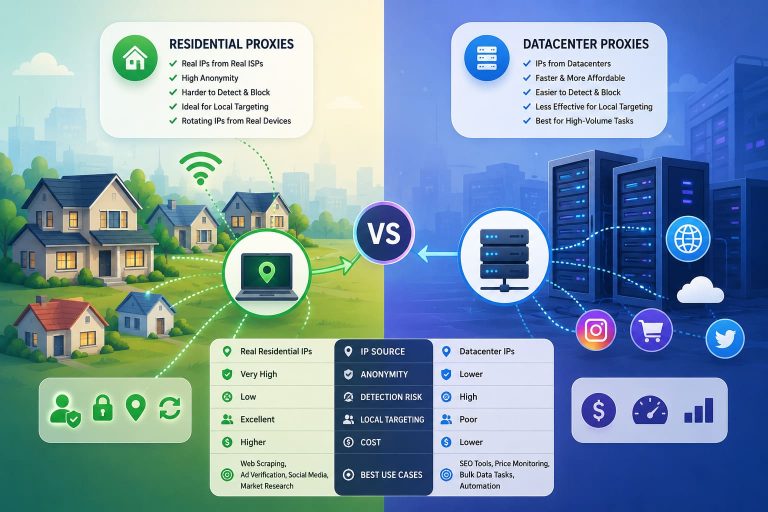
Residential vs Datacenter Proxies: Use Cases and Best Providers (2026)
 Web Scraping
Cloudflare Blocking Scrapers Explained: Your 2026 Guide to Anti-Bot Protection
 Web Scraping
Scrap.io Review 2026: What This Google Maps Lead Generation Tool Actually Gets Right (and Where It Falls Short)
 Web Scraping
User-Agent Rotation: What Actually Works (and What Google Detects in Milliseconds)
 Web Scraping
Robots.txt for Web Scraping Guide In 2026
 Web Scraping