AI agents don’t browse the web as humans do. They fire hundreds of concurrent requests, hold sessions open across multi-step reasoning loops, and rotate through geographies faster than any manual workflow.
That’s why the proxy layer behind a browser agent, MCP, API, LLM-driven scraper, or autonomous research bot matters. Choose the wrong provider, and your agent can get stuck on unreliable IPs, burn through your budget on unexpected bandwidth costs, or hit a wall when you take it from prototype to production.
This guide compares proxy providers for AI-agent workloads and uses transparent evaluation criteria to help you choose the right one for your needs, from enterprise deployments and budget experiments to browser automation, static IPs, and high-concurrency scraping.
Best Proxy Providers for AI Agents at a Glance
| Rank | Provider | Best For | Proxy Types | Geo Coverage | API | Starting Price | Overall Score |
|---|---|---|---|---|---|---|---|
| 1 | Bright Data | Best Overall & Enterprise | Residential, DC, ISP, Mobile | 195 countries | Yes + MCP | Residential $2.50/GB (promo) – $8.40/GB PAYG | 94 |
| 2 | Oxylabs | Best for AI Browser Agents | Residential, DC, ISP, Mobile | 195 countries | Yes + AI Studio SDK | Residential $4/GB (promo) – $8/GB | 92 |
| 3 | Decodo | Best Value / Best for Developers | Residential, DC, ISP, Mobile | 195+ locations | Yes | Residential $2/GB (1TB plan) – $3.50/GB PAYG | 89 |
| 4 | SOAX | Best for Mid-Market Scale | Residential, DC, ISP, Mobile | 195+ countries | Yes | Residential ~$3.60/GB (varies by tier) | 85 |
| 5 | Webshare | Best Budget / Best Datacenter | Residential, DC, ISP | 195 countries (residential) | Yes | Datacenter $0.0299/IP; Residential $1.40/GB | 83 |
| 6 | IPRoyal | Best Non-Expiring Traffic | Residential, DC, ISP, Mobile | 195 countries | Yes | Residential from $1.75/GB (volume) | 80 |
| 7 | DataImpulse | Best Ultra-Budget Residential | Residential, Mobile | 195 countries | Yes | Residential $1/GB PAYG | 78 |
| 8 | Rayobyte | Best US Datacenter Pool | Residential, DC, ISP, Mobile | 100+ countries | Yes | DC from $2.50/proxy; Residential from $0.50/GB (static) | 76 |
| 9 | ScraperAPI | Best Proxy API (Managed) | Managed API (residential/DC pool) | 50+ countries | Yes | ~$49/mo entry tier | 75 |
| 10 | Crawlbase | Best Pay-Per-Request API | Managed API | Global | Yes | Free 20K requests; ~$29/mo entry | 72 |
Prices are based on publicly available pricing as of August 2026. Actual costs may vary depending on your plan, region, and any available promotions. We’ve noted where pricing could not be publicly confirmed.
Our Top Picks
- Best Overall: Bright Data
- Best Enterprise: Bright Data
- Best Value: Decodo
- Best for AI Browser Agents: Oxylabs (AI Studio) and Bright Data (Agent Browser) – near tie
- Best for Developers: Decodo
- Best Residential Proxy Provider: Bright Data
- Best ISP/Static Proxy Provider: Oxylabs
- Best Datacenter Proxy Provider: Webshare
- Best for Large-Scale AI Workloads: Bright Data
- Best Budget Option: DataImpulse (per-GB) / Webshare (per-IP)
1. Bright Data – Best Overall for AI agents
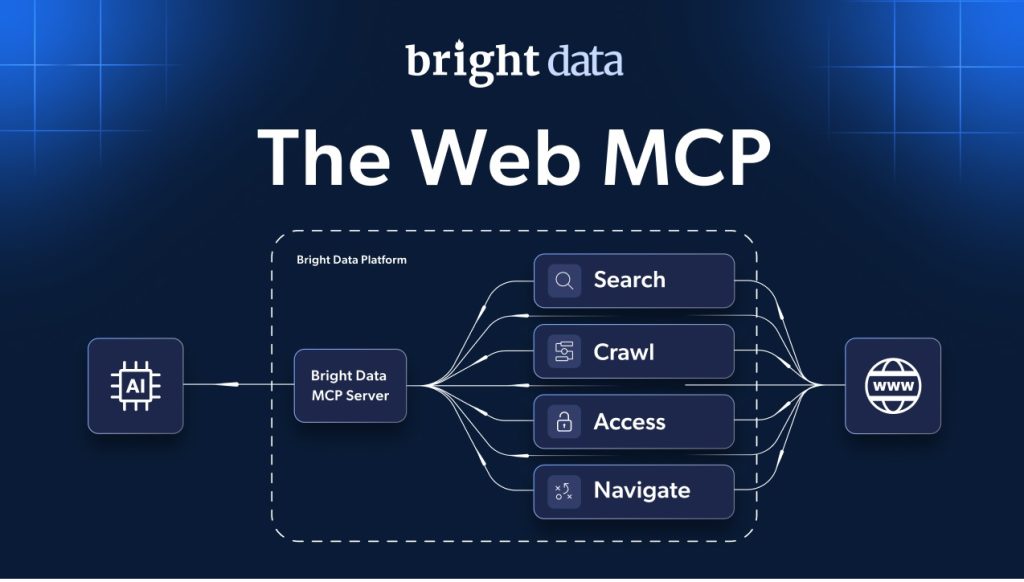
Bright Data offers the widest AI-agent product surface in the industry: proxies plus a purpose-built Agent Browser, a free Web MCP server, KYC-vetted compliance, and the largest publicly documented residential pool. For most serious teams building autonomous agents in 2026, it’s the safest default.
- Best use cases: Enterprise AI agents, large-scale scraping, agentic browser automation, MCP-native LLM apps.
- Proxy types: Residential, datacenter, ISP (static residential), mobile.
- AI-agent suitability: Native MCP server (free tier: 5,000 requests/month), Agent Browser for cloud-hosted browser sessions, Web Unlocker with anti-block handling.
- Technical strengths: Country/city/ASN targeting, session control (rotating and sticky), high concurrency headroom.
- Pricing (verified Aug 2026): Residential from ~$2.50/GB on promo (standard PAYG ~$8.40/GB, ~$3.00/GB on committed plans). Datacenter from $0.90/IP. ISP from $1.30/IP. Web Unlocker ~$3 per 1,000 successful requests.
- Geographic coverage: 195 countries (residential); city and ASN targeting.
- API/developer capabilities: REST API, SDKs, MCP server, integrations with LangChain, Pydantic AI, and Google ADK.
- Advantages: Compliance-first (KYC), largest documented pool, deep AI-agent tooling, fastest to iterate.
- Disadvantages: Premium pricing at PAYG, complex product menu can overwhelm first-time users.
- Who should use it: Enterprises, funded startups, agent platforms that need compliance guarantees.
- Who should avoid it: Solo developers running small experiments on tight budgets.
- Limitations: Enterprise-tier pricing negotiation not publicly confirmed.
2. Oxylabs – Best for AI Browser Agents
Oxylabs has put a strong focus on tools built for AI agents. AI Studio includes an AI Browser Agent, AI Scraper, and AI Crawler, along with a first-party Python SDK and the AI-powered Web Unblocker.
- Best use cases: Browser agents that emulate human behavior, agent-driven scraping, regulated industries.
- Proxy types: Residential (175M+ IPs), datacenter, ISP, mobile (20M+).
- AI-agent suitability: AI Browser Agent, Python SDK, agent-skills GitHub library, MCP-compatible.
- Technical strengths: ~99.95% documented success rate on Web Unblocker, city/ZIP/ASN targeting, unmetered ISP bandwidth.
- Pricing (verified Aug 2026): Residential ~$4/GB on current promo (~$8/GB standard, from ~$3/GB at scale). ISP from $1.60/IP. Web Unblocker from $2.50/GB.
- Geographic coverage: 195 countries.
- API/developer capabilities: Full-featured REST + async APIs, AI Studio SDK, agent-skills library.
- Advantages: Strong ethical sourcing, dedicated AI tooling, high-quality IP pool.
- Disadvantages: Standard pricing is premium; some enterprise features require sales contact.
- Who should use it: Teams building browser-use agents (Playwright, Browser-Use, Operator-style).
- Who should avoid it: Ultra-budget projects.
- Limitations: Some AI Studio quotas not publicly confirmed.
3. Decodo – Best Value & Best for Developers
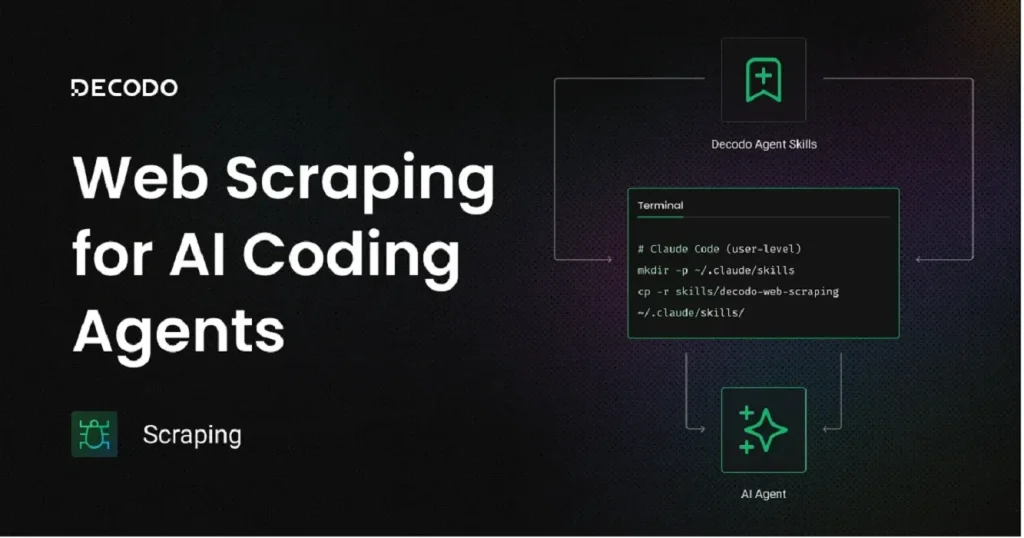
Decodo offers strong, premium-level performance at mid-market prices. Its developer-friendly setup and AI integrations also make it easy to connect scraping tools with LLM workflows.
- Best use cases: Startup AI agents, cost-conscious scraping, developer prototypes moving to production.
- Proxy types: Residential (115M+ IPs), datacenter, ISP, mobile.
- AI-agent suitability: Direct AI model/agent integration with scraping tools; MCP-compatible connectors.
- Technical strengths: Country/state/city/ZIP targeting, unlimited concurrent sessions on residential plans.
- Pricing (verified Aug 2026): Residential from $2/GB on the 1TB monthly plan; PAYG at $3.50–$4/GB. Static residential from $0.27/IP. Mobile ~$4/GB PAYG.
- Geographic coverage: 195+ locations.
- API/developer capabilities: REST API, SDK support, clean docs, sub-user management.
- Advantages: Best price-to-quality ratio, generous free trial, excellent support.
- Disadvantages: Smaller enterprise footprint than Bright Data or Oxylabs; ISP pool is more limited.
- Who should use it: Developers, indie hackers, mid-market teams.
- Who should avoid it: Regulated enterprises that need heavy contractual controls.
- Limitations: Not all AI-agent-specific SLAs are publicly confirmed.
4. SOAX – Best for Mid-Market Scale
SOAX is a solid mid-market option with a 155M+ residential proxy pool, credit-based pricing, and support for HTTP(S), SOCKS5, and UDP/QUIC. The UDP/QUIC support is particularly interesting because it’s not something you see from many proxy providers and can help with latency-sensitive agents.
- Best use cases: Mid-scale AI scraping, ad verification, SEO/localization agents.
- Proxy types: Residential, datacenter, ISP, mobile.
- AI-agent suitability: Sticky sessions, high geo precision, protocol flexibility.
- Pricing (verified Aug 2026): Builder plan $200/month; Scale plan $1,500/month, credit-based (1 credit = $1). Residential effective rate ~$3.60/GB at mid-tier per public reporting.
- Geographic coverage: 195+ countries with city/ISP targeting.
- Advantages: Clean pricing model, strong session controls, UDP/QUIC support.
- Disadvantages: No first-party MCP server confirmed publicly.
- Who should use it: Teams that value predictable, credit-based billing.
- Who should avoid it: Ultra-low-volume experimenters.
5. Webshare – Best Budget & Best Datacenter Provider
Webshare stands out for its low-cost datacenter proxies, useful free tier, and competitive residential pricing. It’s a good fit for AI agents working with less restrictive targets and needing a lot of proxy volume without the cost of premium residential IPs.
- Best use cases: Internal automations, dev/staging agents, high-volume low-risk scraping.
- Proxy types: Datacenter (shared and dedicated), residential (80M+ IPs), ISP.
- AI-agent suitability: Simple API, easy rotation, generous free tier (10 DC proxies + 1 GB/mo).
- Pricing (verified Aug 2026): Datacenter from $0.0299/proxy. Residential from $1.40/GB. ISP from $18/month.
- Geographic coverage: 195 countries (residential).
- Advantages: Lowest DC pricing, transparent per-IP costs, no minimums.
- Disadvantages: DC IPs are shared by default; residential pool smaller than tier-1 providers.
- Who should use it: Budget-conscious devs, teams needing static DC IPs at scale.
- Who should avoid it: Agents targeting sites with strong anti-DC defenses.
6. IPRoyal – Best Non-Expiring Traffic
IPRoyal’s residential traffic does not expire, making it a good fit for AI agents with bursty or unpredictable workloads. Unused traffic remains available for future runs, which can be useful for agents handling tasks such as web research, data collection, and browser automation.
- Proxy types: Residential, datacenter, ISP, mobile.
- Pricing (verified Aug 2026): Residential from $7/GB (1GB) scaling down to $1.75/GB at volume. ISP from $2.40/proxy PAYG.
- AI-agent suitability: Non-expiring GB balances suit intermittent agent runs.
- Advantages: Traffic rollover, ethical sourcing focus, competitive per-GB at scale.
- Disadvantages: No first-party MCP or agent-native product confirmed.
- Who should use it: Teams with unpredictable monthly usage.
7. DataImpulse – Best Ultra-Budget Residential
DataImpulse offers straightforward $1/GB residential PAYG pricing with no monthly minimum, making it a strong budget option for AI agents running variable or experimental workloads.
- Proxy types: Residential, mobile.
- Pricing (verified Aug 2026): Residential $1/GB ($5 entry). Mobile $2/GB. Volume tier: $0.80/GB at 1TB+.
- Geographic coverage: 195 countries.
- Advantages: Lowest published residential rate, no minimum, simple billing.
- Disadvantages: Smaller ecosystem, no dedicated AI-agent stack.
- Who should use it: Cost-sensitive experimenters, indie AI agents.
- Who should avoid it: Buyers needing enterprise SLAs or compliance documentation depth.
8. Rayobyte – Best US Datacenter Pool
Rayobyte is a US-based provider with a large native US datacenter pool and strong ethical-sourcing messaging. It can be a good fit for AI agents that need stable US IPs for web research, browser automation, and location-specific data collection.
- Proxy types: Residential, datacenter, ISP, mobile.
- Pricing (verified Aug 2026): DC from $2.50/proxy (Starter, 5–99 IPs); ISP from $4.60/IP; static residential as low as $0.50/GB.
- Advantages: US infrastructure focus, transparent ethics posture, flexible plans.
- Disadvantages: Residential pool smaller than tier-1 providers.
- Who should use it: US-focused agents, teams that prefer domestic providers.
9. ScraperAPI – Best Proxy API (Managed)
ScraperAPI puts proxies, browsers, and CAPTCHA handling behind a single API endpoint. That makes it a convenient option for AI agents that need web data without having to manage the underlying infrastructure themselves.
- Proxy types: Managed pool (residential and datacenter).
- Pricing (verified Aug 2026): Free tier available; entry plans from ~$49/month.
- AI-agent suitability: Simple single-endpoint API reduces agent complexity; automatic retries and rotation.
- Advantages: Fastest integration for AI agents that don’t want to manage rotation logic.
- Disadvantages: Less granular control than raw proxies; pricing per-record can escalate.
- Who should use it: Teams that want an “API in, data out” model.
10. Crawlbase – Best Pay-Per-Request API
Crawlbase’s pay-per-successful-request model can be a good fit for LLM-powered agents with unpredictable workloads. It can be particularly useful for web research, data extraction, and other workflows where request volumes can vary significantly from one task to another.
- Pricing (verified Aug 2026): Free tier up to 20,000 requests; subscriptions from ~$99/month or pay-as-you-go.
- Advantages: No commitments, easy AI-agent integration, transparent per-request cost.
- Disadvantages: Success-based billing can become opaque without careful monitoring.
How We Ranked the Best Proxy Providers for AI Agents
We used a transparent scoring system to compare each provider. Each one was rated from 0–10 across the key criteria, with more important factors carrying more weight. The final scores were then combined and converted to a 100-point scale.
| Criterion | Weight | What It Measures |
|---|---|---|
| AI-agent suitability | 20% | MCP/SDK support, agent-native products, session control for reasoning loops |
| Proxy quality & reliability | 15% | IP freshness, block rates, documented success rates |
| Geographic coverage | 10% | Country/city/ASN targeting depth |
| Session control & IP management | 10% | Sticky vs rotating, session duration, rotation controls |
| API/developer integration | 10% | REST/SDKs, docs, code samples, framework integrations |
| Performance & latency | 10% | Response time, protocol support |
| Pricing/value | 10% | Cost per GB/IP/request vs. tier-adjusted quality |
| Scalability/concurrency | 5% | Concurrent connection headroom |
| Privacy/compliance/transparency | 5% | KYC, ethical sourcing, published policies |
| Documentation/support | 5% | Depth of docs, support responsiveness |
Scores reflect published documentation, official pricing pages, and public third-party reporting. Where a specification was not publicly confirmed, it did not contribute to the score.
What Makes a Proxy Provider Good for AI Agents?
AI agents behave differently from traditional scrapers. A single autonomous run can involve dozens of tool calls, long-running browser sessions, and multiple steps that need to maintain the same authenticated context. The proxy layer needs to support this kind of workflow reliably.
- IP quality: Residential and mobile IPs tend to blend in better with regular user traffic, while datacenter IPs are cheaper but generally easier to identify.
- Session persistence: Sticky sessions are important for multi-step agents that need to keep cookies and authentication state across requests.
- Rotation: Rotating IPs can help when an agent needs to simulate requests from different users or locations, such as for localization checks.
- Geographic targeting: Country-level targeting is a basic requirement, while city- and ASN-level targeting can be valuable for localized research and region-specific tasks.
- Latency: Agents often chain LLM calls with proxy requests, so added proxy latency can quickly affect the overall response time.
- Concurrency: Modern agent frameworks can run multiple tasks in parallel, making concurrency limits a potential bottleneck as workloads scale.
- API integration: APIs, MCP servers, and SDKs make it easier for agents and the applications running them to manage proxy connections programmatically.
- Compliance: KYC-vetted and transparently sourced providers can reduce legal and operational risk. This is particularly important given the disruption of NetNut, which highlighted the risks associated with residential proxy networks that are not transparently sourced.
Residential vs Datacenter vs ISP Proxies for AI Agents
| Proxy Type | Best For | Speed | Stability | Geo Targeting | Cost | Typical AI-Agent Use |
|---|---|---|---|---|---|---|
| Residential | Public-web research, geo-locked content | Medium | Medium | Excellent | High ($1–$15/GB) | Browser agents, localized research |
| Datacenter | Internal APIs, friendly targets | High | High | Good | Low ($0.03–$2/IP) | Dev/staging agents, bulk fetches |
| ISP (Static Residential) | Account-based automation | High | Very High | Good | Medium ($0.27–$4.60/IP) | Long-lived agent sessions |
| Mobile | Hardest targets | Medium | Medium | Country-level | Highest ($2–$15/GB) | Specialized workloads |
| Rotating | Broad crawls | Varies | Varies | Provider-dependent | Varies | Discovery agents |
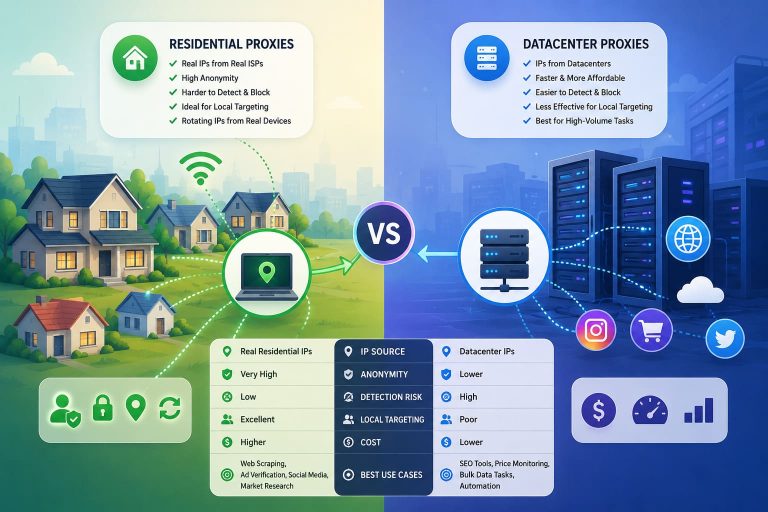
Trade-off summary: Residential IPs generally offer better IP quality but cost more. Datacenter proxies are faster and cheaper but can be easier to detect. ISP proxies offer a middle ground, combining datacenter performance with residential ISP addresses for workloads that need stable identities.
Best Residential Proxy Providers for AI Agents
- Bright Data — largest documented pool, best compliance posture.
- Oxylabs — 175M+ IPs, high success rates, AI Studio integration.
- Decodo — 115M+ IPs at the best value in the tier.
- SOAX — 155M+ IPs, credit-based billing.
- IPRoyal — non-expiring traffic, good mid-market value.
Best Datacenter Proxy Providers for AI Agents
- Webshare — market’s cheapest DC proxies with a real free tier.
- Bright Data — high-performance DC pool with strong tooling.
- Rayobyte — US-focused DC infrastructure.
- Decodo — clean DC APIs for developer workflows.
Best ISP/Static Proxy Providers for AI Agents
- Oxylabs — unlimited bandwidth on ISP, strong SLA posture.
- Bright Data — ISP from $1.30/IP with enterprise controls.
- Decodo — ISP from $0.27/IP, best-in-class entry pricing.
- IPRoyal — flexible PAYG ISP plans.
Best Proxy APIs for AI Agents
For teams that want a single endpoint rather than raw proxies:
- Bright Data Web Unlocker / MCP — deepest integration, free MCP tier.
- Oxylabs Web Unblocker + AI Studio SDK — first-party Python SDK.
- ScraperAPI — simplest integration for AI agents.
- Crawlbase — pay-per-successful-request, generous free tier.
Evaluate on API quality, documentation, authentication (API keys vs. sub-users), geo-targeting granularity, session management, and — critically — concurrency headroom at your target tier.
Best Proxies for AI Browser Agents
Legitimate browser-agent workloads include QA testing, localization checks, authorized automation, and public-web research. The best providers here bundle proxies with browser infrastructure:
- Bright Data Agent Browser — cloud-hosted browsers purpose-built for AI agents.
- Oxylabs AI Browser Agent — part of AI Studio, emulates human interaction patterns.
- Nimble Agent Browser — cloud-based browser platform with built-in unblocking.
These platforms handle the browser lifecycle, so your agent focuses on reasoning, not infrastructure.
Best Proxies for Large-Scale AI Agents
At scale, the questions shift from “cheapest per GB?” to “will this hold up at 10,000 concurrent sessions across 50 countries?”
- Bright Data — highest concurrency ceilings, negotiated enterprise pricing, KYC-verified.
- Oxylabs — 195-country coverage, documented ~99.95% success rate on Web Unblocker.
- SOAX — credit-based Scale plan ($1,500/month) with predictable enterprise billing.
Predictable pricing matters more than headline rates at scale — surprise overages from PAYG plans can eclipse the savings.
Best Budget Proxy Providers for AI Agents
Focus on total cost of ownership, not headline price:
- Per GB: DataImpulse ($1/GB) beats everyone on residential PAYG.
- Per IP (datacenter): Webshare ($0.0299/proxy) is unbeatable.
- Rollover: IPRoyal’s non-expiring traffic favors bursty usage.
- Watch for: minimum commitments, traffic expiration, per-request add-ons, and geo surcharges.
How Much Do Proxies for AI Agents Cost?
| Plan Type | Typical 2026 Range | Notes |
|---|---|---|
| Residential PAYG | $1–$8.40/GB | DataImpulse cheapest; Bright Data premium |
| Residential Committed | $1.75–$5/GB | IPRoyal, Decodo, Oxylabs all competitive |
| Datacenter (shared) | $0.03–$0.50/IP | Webshare cheapest |
| Datacenter (dedicated) | $0.90–$3/IP | Bright Data, Rayobyte |
| ISP/Static | $0.27–$4.60/IP | Decodo cheapest entry; Rayobyte premium |
| Mobile | $2–$15/GB | Highest tier; specialty use |
| Managed API (per request) | $0.002–$0.015 | Crawlbase, ScraperAPI |
Do not compare PAYG rates against committed plans without adjusting — the delta can be 3–4×.
How to Choose the Best Proxy Provider for Your AI Agent
A quick decision framework:
- Enterprise scale, compliance-first? → Bright Data
- Best value at mid-market? → Decodo
- Browser-agent infrastructure? → Oxylabs (AI Studio) or Bright Data (Agent Browser)
- Static/ISP IPs for account-based agents? → Oxylabs or Decodo
- Developer-first, simple API? → ScraperAPI or Crawlbase
- Ultra-low residential budget? → DataImpulse
- Cheapest datacenter? → Webshare
- Non-expiring traffic for bursty runs? → IPRoyal
- US-focused datacenter? → Rayobyte
Are Proxies Safe for AI Agents?
A proxy is a network layer, not a security guarantee. Even when you use a reputable provider, there are still several security considerations to keep in mind:
- Encryption: Use HTTPS or SOCKS5 with TLS where appropriate to protect traffic in transit.
- Credential security: Never hard-code proxy credentials in agent prompts, source code, or client-side applications.
- API key protection: Rotate keys regularly, use separate sub-users where available, and limit permissions to what each workload actually needs.
- Provider trust: Prefer providers that are transparent about KYC, IP sourcing, and ethical-use policies. The NetNut takedown highlights the operational risks associated with poorly vetted proxy networks.
- Logging: Check what the provider logs, how long logs are retained, and whether you can opt out where applicable.
- Data handling: Review the provider’s privacy policy and terms before routing sensitive or personal data through its network.
- Network isolation: Run AI agents in isolated environments with appropriate access controls. A proxy routes traffic; it does not sandbox the code running your agent.
A proxy does not automatically make your AI agent anonymous, compliant, or secure. Those are separate security and engineering concerns that need to be handled at the application, network, and infrastructure levels.
Limitations and Risks
- IP reputation drift: Residential IPs can be flagged if abused by other tenants.
- Latency: Every hop adds real-world time; measure end-to-end, not just proxy round-trip.
- Unreliable connections: All providers see occasional pool degradation.
- Geographic inaccuracies: Geo-IP databases lag reality; verify with test requests.
- Provider restrictions: Most providers prohibit certain target sites in their ToS.
- Unexpected costs: PAYG overages, per-request add-ons, and traffic expiration are common surprises.
- Compliance: GDPR, CCPA, and target-site ToS still apply to your agent.
- Automation restrictions: Respect robots.txt and rate limits — proxies don’t grant permission you don’t already have.
This guide does not cover or endorse bypassing CAPTCHAs, anti-bot systems, authentication, rate limits, paywalls, or other security controls. It focuses on public web data and authorized use cases.
Best Proxy Provider by Use Case
| Use Case | Recommended Provider | Why |
|---|---|---|
| Overall | Bright Data | Broadest agent-native stack + compliance |
| Enterprise AI | Bright Data | KYC, MCP, Agent Browser, enterprise SLAs |
| AI Browser Agents | Oxylabs / Bright Data | AI Studio + Agent Browser respectively |
| Residential | Bright Data | Largest documented pool, city/ASN targeting |
| Datacenter | Webshare | Lowest per-IP pricing with a real free tier |
| ISP/Static | Oxylabs | Unlimited bandwidth, strong reliability |
| Developer/API | Decodo | Clean docs, best price-to-quality ratio |
| Budget | DataImpulse | $1/GB residential, no minimums |
| Large Scale | Bright Data | Concurrency + predictable enterprise pricing |
Provider Final Scores
| Provider | Overall /100 | AI-Agent Suitability | Technical | Value | Developer/API | Reliability |
|---|---|---|---|---|---|---|
| Bright Data | 94 | 98 | 95 | 78 | 96 | 96 |
| Oxylabs | 92 | 95 | 94 | 80 | 94 | 95 |
| Decodo | 89 | 86 | 88 | 94 | 92 | 88 |
| SOAX | 85 | 82 | 86 | 85 | 84 | 86 |
| Webshare | 83 | 74 | 82 | 95 | 82 | 82 |
| IPRoyal | 80 | 74 | 80 | 88 | 78 | 80 |
| DataImpulse | 78 | 72 | 76 | 96 | 76 | 78 |
| Rayobyte | 76 | 70 | 78 | 82 | 76 | 80 |
| ScraperAPI | 75 | 82 | 74 | 78 | 88 | 78 |
| Crawlbase | 72 | 78 | 72 | 82 | 84 | 76 |
FAQs
What are the best proxy providers for AI agents?
The top five for 2026 are Bright Data, Oxylabs, Decodo, SOAX, and Webshare. Each stands out in a different area: enterprise workloads, browser automation, overall value, mid-market scale, and budget-friendly datacenter proxies.
What is the best proxy for AI agents?
Bright Data ranks first overall because it combines a large residential pool with an Agent Browser, a free MCP server, and KYC-based compliance. Together, these make it one of the more complete proxy stacks for agentic workloads.
Do AI agents need proxies?
Not always, but proxies can be important for many real-world web workloads. Public-web agents may encounter geographic restrictions, rate limits, and anti-bot systems that make relying on a single origin IP impractical.
Which proxy type is best for AI agents?
It depends on the workload. Residential IPs are generally better suited to public-web browsing, ISP proxies can work well for long-lived authenticated sessions, and datacenter proxies are often a good fit for internal APIs and less restrictive targets.
Are residential proxies better for AI agents?
They can be, particularly for browsing the open web. Residential IPs tend to blend in better with regular user traffic and may be less likely to encounter IP-based blocks, although they usually cost more than datacenter alternatives.
What is the best residential proxy for AI agents?
Bright Data stands out for pool size and compliance, while Oxylabs is strong on overall quality and Decodo offers a competitive balance of performance and price.
What is the best proxy API for AI agents?
Bright Data’s Web Unlocker and MCP server provide deep integration with AI and agent workflows. ScraperAPI and Crawlbase are simpler alternatives for teams that mainly need a single API endpoint for web data.
Which proxy is best for AI browser agents?
Oxylabs AI Studio and Bright Data Agent Browser are strong options for browser-based workloads, combining browser infrastructure with proxy capabilities designed for automated web tasks.
Are datacenter proxies suitable for AI agents?
Yes, particularly for internal APIs, development environments, and less restrictive targets. They are generally cheaper and faster than residential proxies, but their IPs can be easier to identify.
Are ISP proxies useful for AI agents?
Yes. ISP proxies combine datacenter-style performance with IP addresses associated with residential ISPs, making them useful for workloads that need relatively stable identities and persistent authenticated sessions.
How much do AI-agent proxies cost?
Residential proxy pricing in this comparison ranges from about $1/GB with DataImpulse to $8.40/GB for Bright Data PAYG. Datacenter options can start around $0.03/IP with Webshare, while managed scraping APIs typically range from roughly $0.002 to $0.015 per request. Prices can vary by plan and usage, so check current pricing before buying.
How do I choose a proxy provider for an AI agent?
Match the provider to your workload rather than choosing based on price alone. For example, Bright Data is a strong option for enterprise-scale deployments, Decodo for value, Oxylabs for browser-based workloads, and DataImpulse or Webshare for budget-conscious use cases. Always verify current pricing, limits, and features before committing.
You May Also Like
 Web Scraping
How to Handle CAPTCHA While Scraping: A 2026 Developer’s Guide
 Proxies
Best Proxies for Web Scraping In 2026: How I Choose the Right Provider and Proxy Type
 Proxies
Residential vs Datacenter Proxies: Use Cases and Best Providers (2026)
 Use Cases
Inside Kimwolf Traffic: How Residential Proxies Fuel Credential Stuffing, Web Scraping, & Fraud
 Web Scraping
User-Agent Rotation: What Actually Works (and What Google Detects in Milliseconds)
 Web Scraping
WebGL Fingerprinting in 2026: How It Works and 9 Bypass Methods That Survive Production
 Proxies
Node Unblocker: A Practical Guide for Building a Real Node.js Web Proxy
 Use Cases
API Throttling vs API Rate Limiting in System Design: What Actually Matters in Production
 Web Scraping