Every RAG project eventually collides with the same wall: HTML is hostile to language models. Nav bars, cookie banners, obfuscated class names, hydration artifacts, and JavaScript-rendered content turn what looks like a simple “give me the text” task into a full infrastructure problem. Two tools have become the default answers for AI teams tackling this in 2026: Crawl4AI, the open-source Python crawler with roughly 58K GitHub stars, and Firecrawl, the YC-backed managed API sitting around 100K stars and 96%+ web coverage.
The “which one is better” framing misses the point. These are not the same product with different price tags; they represent two philosophies about where scraping complexity should live. One says “give me the primitives and I’ll assemble the pipeline.” The other says “give me a URL and don’t make me think about Playwright memory limits.”
Having watched teams win and lose with both, the honest answer is that the right choice depends on three variables most comparison articles skip: your extraction consistency requirements, how sensitive your data is to leaving your network, and whether scraping is a product or a utility inside your product. This guide walks through the architecture, benchmarks, and decision logic, then gives you a framework to make the call without guessing.
Key Takeaways
- Crawl4AI is a library; Firecrawl is a service. That single distinction determines 80% of the tradeoffs — infrastructure ownership, cost model, data locality, and time-to-first-scrape.
- Firecrawl wins on reliability out of the box. Independent benchmarks put it at ~95% success rate vs ~90% for Crawl4AI on a mixed 1,000-URL corpus, with a wider gap on anti-bot-protected targets (88% vs 72%).
- Crawl4AI wins on unit economics at volume — if you have the engineering bandwidth to run it. Self-hosted means zero per-page cost, but you inherit browser lifecycle, proxy rotation, and queue management.
- Data locality is the sleeper decision factor. Firecrawl proxies your requests through its infrastructure. For regulated data (healthcare, finance, internal enterprise systems), that alone often decides the tool.
- The credit model creates hidden Firecrawl costs. Credits don’t roll over, and JS-heavy pages, JSON extraction, and stealth mode consume additional credits per page. Model your worst case, not your happy path.
- Neither tool is a silver bullet for anti-bot. Both hit walls on aggressively protected sites. Plan for proxy providers, CAPTCHA solvers, or a residential fallback regardless of your choice.
What Each Tool Actually Is (Beyond the Landing Page)
Crawl4AI: A Playwright-Based Extraction Framework
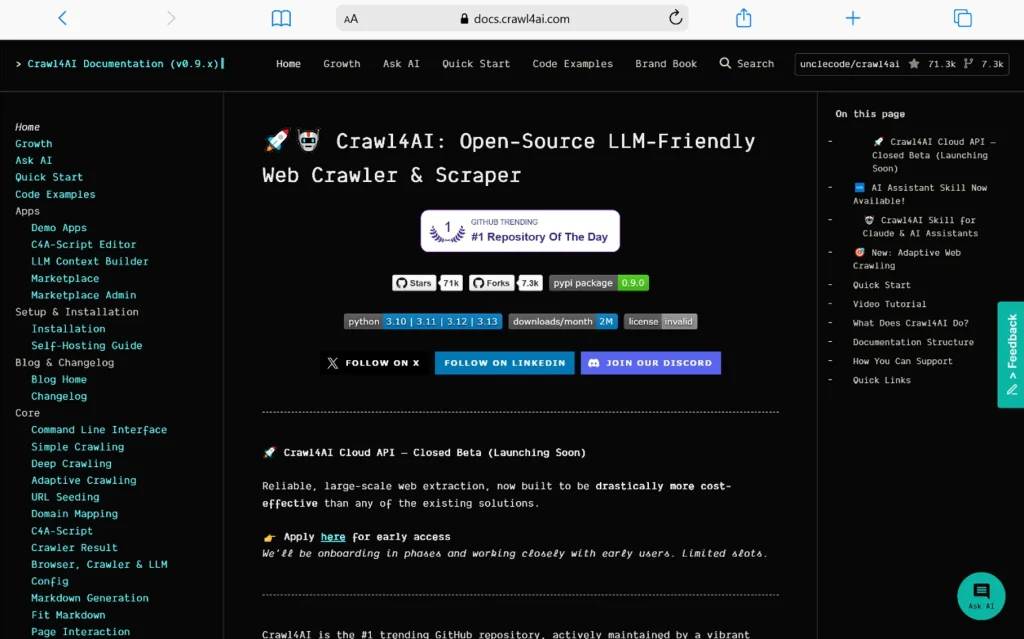
Crawl4AI is an open-source Python library built around AsyncWebCrawler, a Playwright-driven browser controller layered with content-cleaning strategies designed for LLM consumption. The most current release line (v0.9.x) shipped a secure-by-default Docker server, JWT authentication, and treats HTTP request bodies as untrusted trust boundaries — signals that the project is being pushed toward serious self-hosted deployments rather than laptop experiments.
Under the hood, three architectural choices define it:
- Multiple extraction strategies coexist.
JsonCssExtractionStrategyfor schema-driven CSS/XPath extraction,LLMExtractionStrategyfor model-driven extraction via LiteLLM,LLMTableExtractionfor structured tables, and content filters likePruningContentFilterandBM25ContentFilterto trim noise before markdown generation. - Adaptive crawling (v0.7+). Rather than crawling every discovered link, Crawl4AI can score information gain and stop when a query is satisfied — a small but meaningful capability for building focused RAG corpora without ballooning storage or embedding costs.
- Full browser control. Session persistence, remote browser attachment, browser profiles for authenticated crawls, viewport manipulation, iframe traversal, virtual scroll handling — the surface area is closer to Playwright itself than to a “scrape this URL” API.
The tradeoff is honest: you get every knob, and you have to know which knob to turn.
Firecrawl: A Managed Web Context API
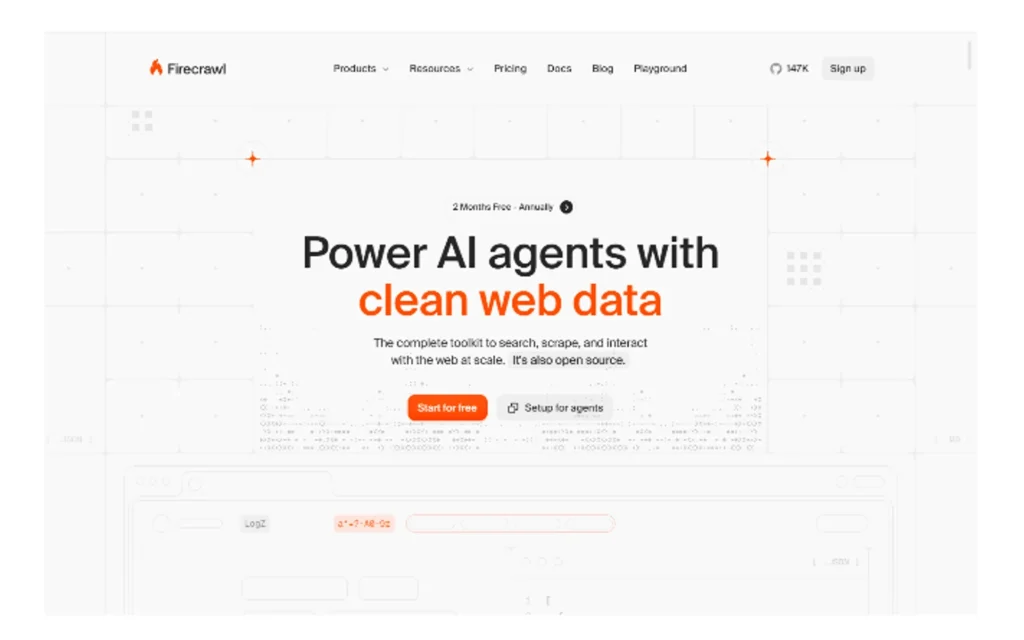
Firecrawl exposes a small, opinionated set of endpoints — /scrape, /crawl, /map, /search, /interact, and the newer /monitor — each returning LLM-ready markdown, structured JSON, or both. You send a URL; Firecrawl handles headless Chromium, JS rendering, retries, rate limiting, and anti-bot mitigation on its infrastructure.
The /extract endpoint deserves attention on its own. Instead of writing selectors, you pass a schema (or a prompt) and Firecrawl runs an LLM extraction pass on the fetched content, returning typed JSON. This is genuinely useful when you’re scraping heterogeneous sites where CSS selectors would need per-domain tuning, competitor pricing, lead enrichment, KYB workflows, but you should understand it as an LLM inference cost hidden inside a scraping bill.
The Distinction That Matters
Crawl4AI hands you a toolkit and expects you to build a pipeline. Firecrawl hands you a pipeline and expects you to send URLs. Almost every operational difference between them descends from that.
Head-to-Head: Feature Comparison
| Dimension | Crawl4AI | Firecrawl |
|---|---|---|
| License / Model | Open source (Apache 2.0), self-hosted | Managed SaaS API (open-core repo available) |
| Language / SDK | Python-first; Docker API for polyglot | REST + SDKs (Python, Node, Go, Rust community) |
| Setup time | 15–60 min (Docker, Playwright, Chromium) | ~2 min (API key + SDK) |
| JS rendering | Playwright (Chromium/Firefox/WebKit) | Managed headless browser |
| Anti-bot defenses | Stealth mode + playwright-stealth; you supply proxies | Managed rotation + stealth mode add-on |
| Extraction strategies | LLM, CSS/XPath, Regex, Cosine, BM25, custom | Markdown default + /extract (schema/prompt) |
| Adaptive crawling | Yes (information foraging, v0.7+) | Limited; /map + selective /scrape is the pattern |
| Data locality | Fully local (your servers) | Traverses Firecrawl infrastructure |
| Scaling model | You provision workers + browsers | Elastic; billed per credit |
| Cost model | Compute + proxies + engineering time | 1 credit per page (scrape/crawl/map/monitor); 2 credits/10 results (search); extras for JSON, stealth |
| Free tier | Fully free (self-hosted) | 1,000 credits/month |
| Paid entry point | N/A | Hobby ~$16/mo, Standard ~$83–100/mo, Growth $100+/mo |
| Best-case throughput | ~19 pages/s static, ~11 pages/s SPA (self-hosted) | ~27 pages/s static, ~14 pages/s SPA (managed) |
| Independent success rate | ~89.7% overall; ~72% on anti-bot targets | ~95.3% overall; ~88.4% on anti-bot targets |
| RAG-quality Recall@5 | ~84.5% (11.3% noise) | ~89.0% (6.8% noise) |
| GitHub traction | ~58K stars | ~100K stars |
Benchmark figures are adapted from the 1000-URL comparative benchmark, which is worth reading in full for methodology.
Why the Benchmark Gap Is Smaller Than It Looks
The success-rate difference, roughly 5 percentage points overall, 15+ points on anti-bot targets reflects default configuration, not architectural ceiling. Crawl4AI ships with stealth mode and proxy support, but you’re responsible for wiring in residential proxies, TLS fingerprint tuning, and retry strategies. Firecrawl bundles that infrastructure into the credit price.
In practice this means:
- A Crawl4AI deployment behind a good proxy pool (Bright Data, Oxylabs, Smartproxy residentials) closes most of the gap on protected sites.
- A Crawl4AI deployment on a naked server with no proxy rotation will underperform Firecrawl badly on anything with Cloudflare, Akamai, or DataDome in front of it.
Reddit users report this pattern consistently: Crawl4AI works cleanly for weeks on cooperative sites, then quietly degrades — dropped requests, memory pressure, Chromium zombie processes — on production workloads without careful infrastructure work. One practitioner running both for four months reported Crawl4AI Docker deployments “started dropping requests randomly after 3 weeks and never found a clean fix.” That’s not a bug in Crawl4AI; it’s the reality of running headless browser fleets. (Reddit r/AgentsOfAI)
The Cost Math Nobody Publishes Honestly
The most misleading pattern in this comparison is treating Crawl4AI as “free” and Firecrawl as “expensive.” Both framings are wrong.
Firecrawl’s Real Cost Curve
At Firecrawl’s Standard tier (~$83–100/month, ~100K credits), effective cost lands near $0.001 per page for basic markdown scrapes. That’s competitive with what most teams spend on proxies and headless Chromium infrastructure at similar volumes.
The traps:
- JSON/extract mode consumes additional credits per page.
- Stealth mode for hardened sites is a premium option.
- Credits don’t roll over on standard plans, so under-consumption is a permanent loss (only auto-recharge credits and Enterprise annual grants persist).
- Pages that return 4xx/5xx from the origin still consume credits — you only get refunded if Firecrawl’s infrastructure fails, not if the target site rejects you.
Model your bill using worst-case assumptions: 80% happy path, 20% requires JSON extraction, 5% requires stealth. Then double the volume estimate for retries and discovery crawls. That’s a defensible budget.
Crawl4AI’s Hidden Costs
Self-hosting isn’t free — it’s differently priced.
- Compute: Each Chromium instance consumes 200–500MB RAM. A worker pool sized for 12 pages/s sustained throughput realistically needs 4–8 GB of RAM per node, plus CPU headroom for JS execution.
- Proxies: Residential proxy pools capable of handling anti-bot sites run $2–15 per GB depending on provider and geo. For meaningful scraping volume, this is often the largest line item.
- Engineering time: Queue management, dead worker detection, retry logic, TLS fingerprint rotation, storage, deduplication — all things Firecrawl’s price includes. Budget 20–40 hours of senior engineering time for initial hardening, then ~2–5 hours per month for ongoing maintenance.
- LLM extraction: If you use
LLMExtractionStrategy, you’re paying per-token to OpenAI/Anthropic/local model on top of everything else.
For a team scraping ~500K pages/month of mixed content, my back-of-envelope math typically lands within 30% between the two — Crawl4AI wins only if you already have the infrastructure and someone whose job includes maintaining it.
Expert Insights: Where Conventional Advice Gets This Wrong
- “Open source is always cheaper at scale.” Not really. Open source is cheaper at scale if the total cost of ownership curve stays flat as volume grows. For browser-based scraping, TCO grows non-linearly — proxy consumption scales with anti-bot difficulty, and browser fleets get harder to manage as you multiply nodes. Firecrawl’s marginal cost stays predictable in a way self-hosted Playwright doesn’t.
- “Managed APIs lock you in.” True in theory, weaker in practice. Both tools return markdown as their primary artifact. A migration from Firecrawl to Crawl4AI (or vice versa) is mostly a matter of swapping the fetch layer — your chunking, embedding, and retrieval code stays untouched. Design your pipeline with a thin adapter between the crawler and the rest, and vendor lock-in becomes weeks of work, not quarters.
- “Just use requests and BeautifulSoup for simple sites.” This holds for static HTML only. In 2026, the tipping point where you need a browser has shifted dramatically — React, Next.js, and hydration-heavy patterns dominate even documentation sites and marketing pages. If you’re building anything you plan to run for more than a quarter, invest in the browser tier upfront.
- “LLM extraction beats CSS selectors.” Sometimes. LLM extraction shines on unstructured or heterogeneous pages. On structured, high-frequency targets (product pages, job listings, real estate), CSS-based extraction via
JsonCssExtractionStrategyis faster, cheaper, and more deterministic. The right pipeline uses both, routed by page type. - “Adaptive crawling isn’t important.” For general-purpose scraping, correct. For focused RAG corpus building — the exact use case most AI teams have — it changes the economics materially. Crawling 200 relevant pages instead of 2,000 saves storage, embedding compute, retrieval noise, and target-site goodwill.
Real-World Decision Scenarios
Scenario 1: Startup Building a Vertical AI Agent
A three-person team building a legal research agent needs to ingest a few thousand court filings monthly, plus targeted news scraping. Time-to-market matters more than unit economics.
Recommendation: Firecrawl. The team has no infrastructure engineer, the volume fits comfortably in the Standard tier, and the /extract endpoint eliminates the need to write case-by-case selectors for filings from different courts.
Scenario 2: Enterprise Data Team Building Internal RAG
A Fortune 500 data platform team ingesting internal wikis, Confluence exports, and gated partner portals to feed an internal Claude/GPT-4o assistant.
Recommendation: Crawl4AI. Data cannot leave the corporate network. Firecrawl is disqualified on data locality alone. Crawl4AI self-hosted inside the VPC, with session-based authenticated crawls of internal systems, is the correct architecture.
Scenario 3: E-Commerce Intelligence Startup at 5M Pages/Month
A team scraping global retailer catalogs for competitive pricing intelligence, dealing with Akamai, DataDome, and PerimeterX-protected sites at meaningful volume.
Recommendation: Neither alone, and possibly a hybrid. At this volume and anti-bot difficulty, you likely need Bright Data / Oxylabs Web Unlocker or Zyte Smart Proxy Manager fronting either tool. Crawl4AI + residential proxies gives you the most control over cost and rotation. Firecrawl gives you a smaller ops footprint but climbs cost curves rapidly with stealth-mode credits.
Scenario 4: LangChain / LlamaIndex Prototype
A single engineer prototyping a RAG system with LangChain document loaders or LlamaIndex ingestion pipelines against ~50 documentation sites.
Recommendation: Firecrawl in prototype, evaluate Crawl4AI at production. Both tools have LangChain and LlamaIndex adapters. Firecrawl’s zero-setup path lets you validate the retrieval hypothesis before investing in infrastructure. If the prototype scales, revisit.
Scenario 5: Agent Framework with User-Directed Web Actions
An AI agent product where users trigger scrapes on arbitrary URLs at unpredictable volumes.
Recommendation: Firecrawl, primarily because of the /interact endpoint and predictable per-request billing. Self-hosted Crawl4AI struggles with unpredictable load spikes without over-provisioning.
Common Mistakes Teams Make
Choosing based on GitHub stars. Popularity is a lagging indicator, and it conflates “widely tried” with “widely deployed in production.” Star counts don’t tell you which tool your team can actually operate.
Underestimating browser memory pressure. Chromium is not lightweight. A common failure mode with Crawl4AI is starting with a single worker on a modest VM, hitting throughput limits, then discovering that horizontal scaling requires solving job queues, dead-worker detection, and shared session state — all things teams didn’t plan for.
Treating credits as fungible. Firecrawl users often model cost using scrape credits and forget that JSON extraction, stealth mode, /search, and /interact have different credit economics. Read the credits table before signing a Standard or Growth plan.
Building without a fallback strategy. Both tools fail on some targets. Production pipelines need at least a two-tier strategy: primary crawler, then a fallback (a different tool, a residential proxy service, or manual retry with different fingerprint). Teams that skip this discover it in incident review, not during architecture.
Skipping robots.txt and rate limiting. Both tools support respecting robots.txt. Teams disable it “temporarily” for testing and forget. That’s a lawsuit and IP-ban vector waiting to happen. Set organization-level defaults, not per-script decisions.
Ignoring markdown quality until embedding time. The 4.5-point recall gap between Firecrawl and Crawl4AI (89% vs 84.5% Recall@5 in the Spider benchmark) doesn’t matter until you’re debugging why your RAG is retrieving nav bars and cookie banners. Test markdown quality against your target sites before committing.
A Decision Framework
Answer these six questions in order. The first “no” often decides the tool.
- Does your data have to stay on-premise or in your VPC? If yes → Crawl4AI. Firecrawl proxies through its infrastructure.
- Do you have (or want) an engineer whose job includes maintaining scraping infrastructure? If no → Firecrawl. Running Playwright fleets is a specialty.
- Is your monthly page volume predictable within ±30%? If no → Firecrawl. Elastic managed billing handles spikes; self-hosted infrastructure sits idle or drops requests.
- Are more than 40% of your targets aggressively anti-bot protected? If yes → Neither is sufficient alone. Plan for a proxy layer or Bright Data / Zyte on top of whichever crawler you pick.
- Do you need custom extraction strategies per site (CSS, LLM, regex mixed)? If yes → Crawl4AI. Firecrawl’s
/extractis capable but less flexible. - Is time-to-first-scrape more important than unit economics? If yes → Firecrawl. The 2-minute setup is real.
Key Features Worth Knowing
Crawl4AI standout capabilities
- Adaptive crawling with information-foraging halt criteria (native since v0.7)
- Multiple extraction strategies composable in one pipeline (
JsonCssExtractionStrategy,LLMExtractionStrategy,LLMTableExtraction) - Session and profile persistence for authenticated crawls
- Virtual scroll and lazy-load handling for modern SPAs
- Secure-by-default Docker API server (v0.9.x) with JWT authentication
- Full markdown citation and reference generation
- BM25 and cosine content filtering before LLM handoff
- Native support for Chromium, Firefox, and WebKit engines
Firecrawl standout capabilities
/extractendpoint with schema-driven or prompt-driven LLM extraction/mapendpoint for cost-efficient site discovery before scraping/interactendpoint for click, type, and dynamic form interactions/monitorfor always-on change detection- Automatic Cloudflare, Akamai, and DataDome handling on managed infrastructure
- Consistent markdown output quality across heterogeneous sites without per-domain tuning
- LangChain, LlamaIndex, and MCP-compatible integrations out of the box
- Elastic scaling from 1 to 100K+ pages per API call
Practical Recommendations
For teams starting today, my defaults look like this:
Prototype phase (weeks 0–4): Start with Firecrawl regardless of your long-term plan. The 1,000-credit free tier gives you enough surface area to validate that your RAG or agent hypothesis works before you spend engineering time on infrastructure.
Early production (weeks 4–12): Stay on Firecrawl if volume is under 100K pages/month and your data isn’t regulated. Migrate to Crawl4AI if either constraint pushes back — but do it with a thin adapter interface so you can switch again later.
Scale phase (100K+ pages/month): Model both options with real numbers. Include proxy costs, engineering time, and worst-case retry rates. In my experience, the crossover point where Crawl4AI plus infrastructure beats Firecrawl on TCO sits somewhere between 500K and 2M pages/month depending on anti-bot difficulty — but the operational overhead only makes sense if you have the team.
Regulated or sensitive data: Crawl4AI in your VPC, full stop. Don’t design your way around this.
Hybrid pattern worth considering: Firecrawl for external, heterogeneous, anti-bot-protected sites; Crawl4AI for internal, high-volume, structured sources where you control the target. The two tools coexist cleanly behind a common adapter interface.
Frequently Asked Questions
Which is better for RAG pipelines: Crawl4AI or Firecrawl?
Firecrawl produces marginally cleaner markdown out of the box (89% vs 84.5% RAG Recall@5 in independent benchmarks), which matters for retrieval quality. Crawl4AI gives you more control to tune extraction per site, which matters more when your corpus is domain-specific and you’re willing to invest in per-domain filters. For general-purpose RAG with heterogeneous sources, Firecrawl. For focused, high-value corpora, Crawl4AI with content filters.
Can Crawl4AI handle Cloudflare and DataDome?
Partially. Crawl4AI ships stealth mode and playwright-stealth integration, which defeats basic bot detection. Aggressive protection (Cloudflare Enterprise, DataDome, PerimeterX) will require additional residential proxies and often a paid unlock service. Success rates on anti-bot targets sit around 72% in independent testing without those additions.
Is Firecrawl actually open source?
The core Firecrawl codebase is open source and self-hostable, but the practical value of the service — managed infrastructure, anti-bot handling, elastic scale — lives in the hosted API. Self-hosting Firecrawl is possible but negates most of its advantages over Crawl4AI, which was designed for self-hosting from day one.
How do Crawl4AI and Firecrawl integrate with LangChain and LlamaIndex?
Both have community and official adapters. Firecrawl offers a FirecrawlLoader in LangChain and a reader integration in LlamaIndex. Crawl4AI’s outputs (markdown, structured JSON) drop cleanly into either framework’s document ingestion path. Neither integration is a bottleneck; the crawler choice is decoupled from your framework choice.
What’s the real monthly cost of running Crawl4AI in production?
For a workload of ~500K pages/month with moderate anti-bot difficulty: expect $200–800 in residential proxy costs, $100–300 in cloud compute (2–4 worker nodes with 8GB RAM), and 5–10 hours of engineering maintenance monthly. Total: $500–1,500/month plus engineering time. Compare against Firecrawl’s Standard/Growth tier at $83–250/month before extras.
Which tool is better for scraping JavaScript-heavy sites?
Both handle JS-heavy sites via headless browsers. Firecrawl benchmarks slightly higher throughput on SPAs (14 vs 11 pages/s) because of managed browser pooling. Crawl4AI matches Firecrawl on capability but requires you to tune browser resource limits and session handling yourself.
Does Firecrawl work with AI agents?
Yes, explicitly. Firecrawl publishes an agent-onboarding SKILL specification and supports WorkOS ID-JAG authentication for agent platforms. The /interact endpoint is designed for agent-driven actions on live pages. For agent frameworks like LangGraph, CrewAI, or custom orchestrators, Firecrawl is generally the lower-friction choice.
Can I use Crawl4AI without Docker?
Yes. Crawl4AI is available as a pip package (pip install crawl4ai) and runs as an in-process Python library. Docker is only required for the API server deployment. For single-application use, pip installation is sufficient and avoids the v0.9.x self-hosted server complexity entirely.
What are the best alternatives to Crawl4AI and Firecrawl?
Depending on requirements: Spider (Rust-based, extremely fast), Bright Data Web Scraper API (enterprise, deep proxy network), Zyte (managed with anti-bot focus), Apify (actor marketplace model), ScrapingBee (simple managed API), and Playwright + custom infrastructure (maximum control). Also worth evaluating: Skyvern for agent-driven scraping, and Diffbot for knowledge graph extraction.
How do I choose between Crawl4AI or Firecrawl for a new project in 2026?
Default to Firecrawl for prototyping and anything under 100K pages/month. Move to Crawl4AI when data locality, extraction customization, or unit economics push you there — and only if you have the team to run headless browser infrastructure in production.
Conclusion
The Crawl4AI vs Firecrawl decision looks technical, but it’s mostly organizational. Crawl4AI rewards teams with infrastructure discipline and punishes teams without it. Firecrawl rewards teams who want scraping to be a solved subproblem and charges accordingly. Neither is objectively better — they’re built for different failure modes.
The teams I’ve seen succeed with either tool share one habit: they abstract the crawler behind a narrow interface early, so the choice is reversible. That’s the actual lesson worth internalizing. The specific tool you pick in Q3 2026 may not be the tool you’re running in Q3 2027. LLM-ready web crawling is still moving quickly — adaptive crawling, agent-native APIs, and cheaper stealth infrastructure are all live areas of development.
Pick based on your constraints today, build with the assumption that you’ll swap tools at least once, and don’t let a scraping choice become the load-bearing wall of your AI stack.
You May Also Like
 Web Scraping
What Is Web Scraping and How Does It Work? A Complete 2026 Guide
 Web Scraping
How to Handle CAPTCHA While Scraping: A 2026 Developer’s Guide
 Proxies
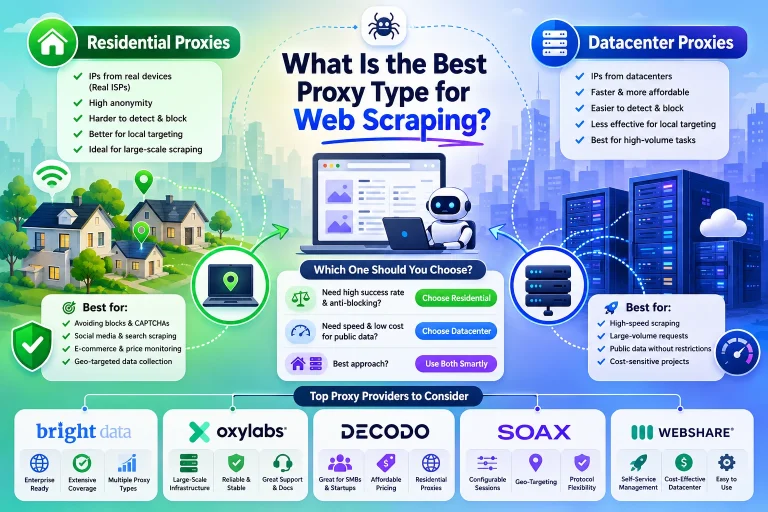
Best Proxies for Web Scraping In 2026: How I Choose the Right Provider and Proxy Type
 Web Scraping
Cloudflare Blocking Scrapers Explained: Your 2026 Guide to Anti-Bot Protection
 Web Scraping
How Google Maps Scraping Actually Works (And Where Most Attempts Go Wrong)
 Web Scraping
Scrap.io Review 2026: What This Google Maps Lead Generation Tool Actually Gets Right (and Where It Falls Short)
 Web Scraping
The 7 Best PHP Web Scraping Libraries of 2026: The Ultimate Guide
 Web Scraping
User-Agent Rotation: What Actually Works (and What Google Detects in Milliseconds)
 Web Scraping